
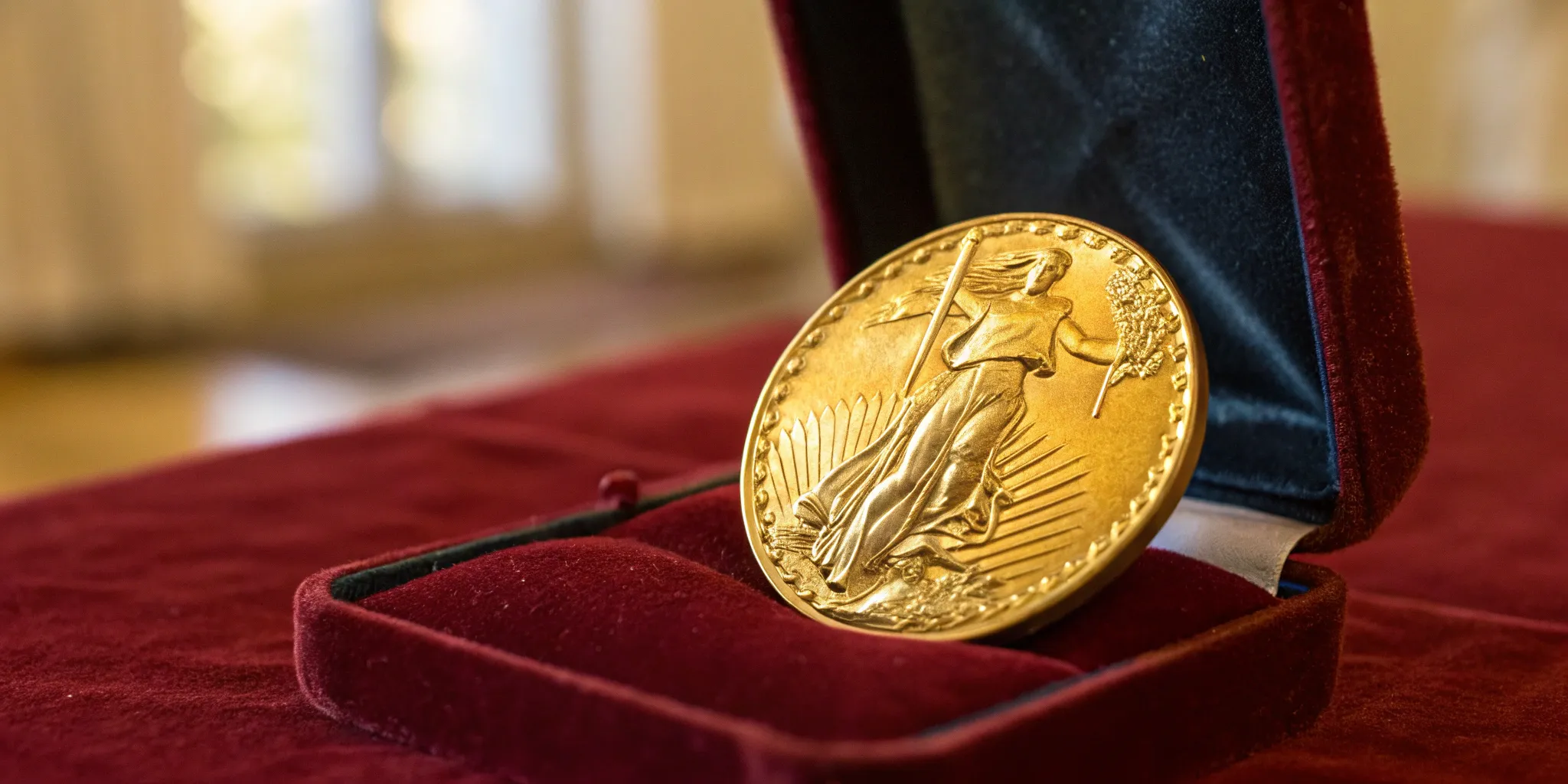
 The 1933 Saint-Gaudens Double Eagle is a coin that was never supposed to exist. Born in the depths of the Great Depression, it was ordered to be melted down by President Franklin D. Roosevelt before it ever reached the public. Yet, a handful escaped, becoming fugitives hunted by the Secret Service for decades. This dramatic backstory of government seizure and clandestine survival is the primary reason for its legendary status. Understanding this history is essential to grasping the true 1933 $20 gold coin value, which culminated in a record-breaking $18.9 million sale for the single specimen legal for private ownership.
Key Takeaways
- Its Value Comes From Its Forbidden Status: The 1933 Double Eagle's price isn't about its gold content; it's about its story. Because President Roosevelt ordered nearly all of them melted down before they were ever released, the few that survived became legendary symbols of a pivotal moment in U.S. history.
- Understand the Strict Legality: With only one exception, the U.S. government views all 1933 Double Eagles as stolen property subject to seizure. The single legally ownable coin is defined by unique government documentation, making any other specimen offered for sale an immediate red flag.
- It's the Ultimate Trophy Piece: The 1933 Double Eagle isn't a standard portfolio diversifier; it's a legacy asset. Its value is driven by extreme rarity and historical significance, placing it in a class of its own and representing the absolute pinnacle of numismatics.
The Story Behind the World's Most Famous Coin
The 1933 Saint-Gaudens Double Eagle isn't just a piece of gold; it's a relic of a pivotal moment in American history. Its story is filled with presidential orders, economic turmoil, and a government-led hunt for a few coins that escaped the melting pot. Understanding its past is the key to appreciating why it became the most valuable coin in the world. The journey begins during one of the nation's darkest financial hours, when the government made a decision that inadvertently created a numismatic legend.
Why Roosevelt Ordered All Gold Melted Down
In the depths of the Great Depression, President Franklin D. Roosevelt took drastic measures to stabilize a failing economy. In 1933, he issued an executive order making it illegal for private citizens to own most forms of gold. This was part of a larger plan to take the country off the gold standard and give the government more control over the money supply. As a result, the U.S. Mint was ordered to halt the release of all new gold coins and melt down the entire mintage of the 1933 $20 Double Eagles. This single act set the stage for the coin's incredible rarity.
How the Great Depression Halted Coin Production
The Saint-Gaudens Double Eagle, first minted in 1907, was widely considered one of America's most beautiful coins. Its production ran until 1933, the year gold coinage was discontinued for circulation. The economic collapse of the Great Depression fundamentally changed the role of precious metals in the U.S. monetary system. Gold was no longer meant for everyday transactions but was instead consolidated in federal reserves. The 1933 issue was struck but never officially released to the public, marking an abrupt end to an era of classic American rare coins for sale.
The Great Melt: Why So Few 1933 Double Eagles Survived
While the U.S. Mint produced 445,500 of the 1933 Double Eagles, nearly all of them met their fate in the melting pot. However, a handful of coins managed to escape. It's believed that a Mint cashier illicitly swapped them for earlier-dated coins before the melt, selling them to a Philadelphia jeweler named Israel Switt. The Secret Service discovered the theft and spent years tracking down these escaped coins. Out of the original mintage, only 13 are known to exist today. This incredible scarcity, born from a government recall and a clandestine act, is the primary reason for the coin's legendary status and immense value.
What Makes the 1933 Double Eagle So Rare?
The rarity of the 1933 Double Eagle isn't just about a low mintage; it's the result of a perfect storm of economic crisis, a presidential decree, and a government crackdown. While 445,500 of these magnificent gold coins were struck at the Philadelphia Mint, they were never officially released into circulation. President Franklin D. Roosevelt’s Executive Order 6102 recalled gold from the public to combat the Great Depression, and nearly all the 1933 Double Eagles were ordered to be melted down. The few that escaped this fate became the subject of a decades-long federal investigation, creating a legend that fascinates collectors to this day.
The Surviving Few: Only 13 Known Coins
Out of the nearly half-million coins originally minted, only 13 are known to exist today. This incredible scarcity is the primary driver of its value. The whereabouts of these survivors are well-documented: two are permanently housed in the U.S. National Numismatic Collection at the Smithsonian Institution, and ten more are securely held in the United States Bullion Depository at Fort Knox. That leaves just one single specimen that is legally permitted to be in private hands. This extreme rarity means that for collectors, the 1933 Double Eagle isn't just a coin; it's a piece of history that almost vanished completely.
The Secret Service Hunt for Missing Coins
The story of the surviving coins reads like a detective novel. Before the mass melting, a handful of 1933 Double Eagles were illicitly removed from the U.S. Mint, allegedly by a cashier who sold them to a Philadelphia jeweler named Israel Switt. When these coins began appearing on the market, it triggered a swift response from the Secret Service. For years, federal agents worked to track down and seize every specimen they could find, arguing they were stolen government property. This determined pursuit is why so few examples remain outside of federal custody and adds a layer of intrigue you won't find with other rare coins for sale.
A Royal Connection: The King Farouk Specimen
The most famous of all is the single privately owned coin, known as the King Farouk specimen. It was originally purchased by King Farouk of Egypt, who had secured a U.S. export license for it before the coins were deemed illegal. After the king was deposed, the coin disappeared for decades before resurfacing in New York. Following a lengthy legal battle, the U.S. government agreed to legalize its private ownership. This specific coin was sold at a 2002 auction for nearly $7.6 million, and in 2021, it shattered records again, selling for an incredible $18.9 million. Its royal provenance and record-breaking sales have cemented its status as the world's most valuable coin.
What Drives the Value of a 1933 Double Eagle?
The staggering value of the 1933 Double Eagle isn't tied to just one factor; it's a perfect storm of rarity, history, and market dynamics. Unlike other coins valued primarily for their gold content or condition, the 1933 specimen is a legend. Its worth is driven by an incredible backstory, its near-extinction by government order, and the insatiable demand from the world's most elite collectors. Understanding these key drivers is essential to appreciating why this coin is more than just currency—it's a piece of history you can hold in your hand. Four main pillars uphold its monumental valuation: its physical condition, its documented history, its official certification, and the intense desire to own it.
Why Grade and Condition Are Crucial
For most Saint-Gaudens Double Eagles, a coin is worth little more than its weight in gold unless it’s in pristine condition. With the 1933 Double Eagle, this principle is magnified. Since these coins were struck but never issued for circulation, they are expected to be in mint state. Even the slightest imperfections can significantly impact their perceived value among top-tier collectors. Professional grading services provide a standardized assessment of a coin's physical state, examining its luster, strike, and any surface marks. For a coin of this caliber, a high grade from a reputable service isn't just a bonus—it's an absolute requirement to command a record-breaking price. Every detail matters when you're dealing with one of the finest rare coins for sale in the world.
Provenance: Tracing a Coin's Unique History
A coin's story, or provenance, adds a layer of value that goes far beyond its physical attributes. The 1933 Double Eagle has one of the most dramatic histories in all of numismatics. The tale of the "Farouk specimen," named after King Farouk of Egypt, is filled with international intrigue, legal battles, and a decades-long pursuit by the Secret Service. A documented chain of ownership confirms a coin's authenticity and adds to its mystique. For serious collectors, owning a piece with a clear and compelling history is paramount. This traceable lineage transforms the coin from a simple collectible into a historical artifact, making it infinitely more desirable.
The Importance of Authentication and Certification
With a coin this famous and valuable, authentication is non-negotiable. The market is unforgiving of forgeries, and the only way to ensure a 1933 Double Eagle is genuine is through certification by a top-tier grading service like PCGS or NGC. These organizations provide an expert, unbiased opinion on a coin's authenticity and condition, encapsulating it in a protective holder with a unique serial number. This certification is the bedrock of trust in the numismatic market. For the 1933 Double Eagle, it’s even more critical, as it officially distinguishes the single legally ownable specimen from any others that were tracked down and destroyed by the government. It’s the ultimate seal of approval for a piece of gold bullion unlike any other.
Market Demand from Elite Collectors
At its core, the value of the 1933 Double Eagle is driven by simple supply and demand—except in this case, the supply is limited to a single coin. With only one specimen legal for private ownership, it is the definition of rare. This coin is widely considered a "trophy piece," the pinnacle of any world-class collection. The desire to own this unique piece of American history creates intense competition among high-net-worth individuals and serious investors. When the Farouk specimen comes to auction, it’s not just a sale; it’s a global event. This fierce demand from a small pool of elite buyers is what pushes its value into the stratosphere, cementing its status as the world's most valuable coin.
How Much Is a 1933 Double Eagle Worth Today?
The 1933 Double Eagle isn't just a coin; it's a legend in the world of numismatics. Its value is a direct reflection of its incredible rarity and the dramatic story behind its creation and survival. While putting a price tag on an object this rare is complex, recent sales have given us a clear benchmark for its staggering worth. The coin's journey through history, from the U.S. Mint to the world's most exclusive collections, has cemented its status as the pinnacle of coin collecting. Its value is driven by a unique combination of historical significance, extreme scarcity, and intense demand from the world's most serious collectors.
The Record-Breaking $18.9 Million Sale
In June 2021, the only 1933 Double Eagle legally available for private ownership shattered records when it sold at a Sotheby's auction. The final price, including fees, was an astonishing $18.9 million, making it the most valuable coin ever sold. This specific coin, known as the Weitzman Specimen, was purchased by an anonymous buyer, adding another layer of mystique to its story. The sale captured global attention, not just within the numismatic community but among investors and art collectors worldwide. This landmark event confirmed the 1933 Double Eagle's position as a one-of-a-kind treasure, a true masterpiece of American coinage whose market value continues to captivate collectors.
Tracking Its Price Appreciation Over Time
The 2021 sale wasn't the first time the Weitzman Specimen made headlines. In 2002, the very same coin was sold for $7.59 million. The fact that its value more than doubled in less than two decades is a powerful testament to its strength as a tangible asset. This remarkable appreciation showcases the growing demand for ultra-rare historical artifacts. Unlike assets tied to fluctuating markets, the value of the 1933 Double Eagle is anchored in its irreplaceable status. This consistent growth highlights the long-term potential of investing in rare coins and solidifies the Double Eagle's reputation as a premier investment piece for discerning collectors.
Understanding the Valuation of Each Specimen
The core driver of the 1933 Double Eagle's value is its extreme rarity. Of the 445,500 originally minted, almost all were ordered to be melted down before they ever entered circulation. Today, only 13 coins are known to exist. Two are held by the U.S. National Numismatic Collection at the Smithsonian, ten are secured at the Fort Knox Bullion Depository, and only one—the Weitzman Specimen—is in private hands. This incredible scarcity means that the coin's value is not tied to its gold content but to its status as a near-mythical artifact. Any valuation must consider its unique historical context and the unparalleled demand from collectors who want to own a piece of history.
Can You Legally Own a 1933 Double Eagle?
This is one of the most common questions surrounding this legendary coin, and the answer is fascinatingly complex. For collectors, the short answer is no. With one single, very famous exception, all 1933 Double Eagles are considered stolen property by the United States government and are illegal to own. This isn't just a matter of policy; the Secret Service has actively pursued and confiscated these coins for decades. The story of why they are illegal—and how one managed to escape this fate—is a crucial piece of numismatic history that every serious investor should know.
Understanding the legal landscape is the first step for any collector interested in the world of ultra-rare coins for sale. The coin's status is tied directly to President Franklin D. Roosevelt's 1933 executive order that took the U.S. off the gold standard and recalled gold coins from the public to be melted down. The Philadelphia Mint had already produced 445,500 Double Eagles dated 1933, but before they could be released into circulation, the order came down to destroy them. Because they were never officially issued as legal tender, they were all supposed to be destroyed. The few that slipped out of the U.S. Mint did so illicitly, which is the root of the ownership issue that persists to this day. Any 1933 Double Eagle that appears on the market is subject to seizure without compensation.
Understanding Federal Ownership Rules
The federal government's position is firm: it is illegal for any private citizen to own a 1933 Double Eagle. The only exception is the single specimen that was officially monetized by the U.S. Treasury after a lengthy legal process. All other known examples are considered property of the United States that was stolen from the Mint. This isn't ancient history, either. The government has a long track record of seizing these coins whenever they surface, from private collections to public auctions. For collectors, this means any offer to sell a 1933 double eagle should be seen as a major red flag, as the coin is almost certainly contraband that will be confiscated.
The Story of the Only Privately Owned Coin
The one legal coin, known as the Weitzman Specimen, has a story worthy of a Hollywood movie. It’s believed to have been part of a group of coins that left the Mint in the 1930s and eventually made its way into the collection of King Farouk of Egypt. After a long journey involving a secretive auction and a Secret Service sting operation, a legal battle ensued. Ultimately, the government reached a unique settlement, agreeing to issue a document that officially monetized this single coin, making it legal to own. This specimen first sold at auction for $7.59 million in 2002. In 2021, it shattered records again, selling for an incredible $18.9 million, making it the most expensive coin ever sold.
Essential Documentation for Legal Ownership
What makes the Weitzman Specimen legal while all others are not? It comes down to a one-of-a-kind document. As part of the legal settlement, the U.S. Mint issued a certificate of monetization for this specific coin. This piece of paper officially transformed it from unissued, illegal bullion into a legal tender coin that could be privately owned. This documentation is unique to this single coin and cannot be replicated. For any other 1933 Double Eagle, no such paperwork exists or can be created. This is why provenance and certification are so critical in the world of high-end numismatics. Without this specific, government-issued document, any 1933 Double Eagle is simply not legal to own, and its value is effectively zero to a legitimate collector.
Where Can You Find a 1933 Double Eagle?
Acquiring a 1933 Double Eagle isn't like buying other rare coins. You won't find one at a local coin show or in a typical online listing. This is the pinnacle of numismatic collecting, and the hunt happens in a very exclusive world. Given that only one is legal for private ownership, any opportunity to acquire it is a global event. If another were ever to be legalized and come to market, you would need to be prepared to act through the right channels.
Working with Major Auction Houses and Dealers
When the world’s only privately owned 1933 Double Eagle changes hands, it does so on a global stage. The last sale, which brought in a staggering $18.9 million, was handled by Sotheby's, a major international auction house. These transactions are monumental events, attracting the most serious collectors on the planet. To even get a seat at the table, you need to work with a trusted dealer who has the connections and expertise to guide you. An established firm can vet the opportunity, help you understand the bidding process, and ensure every detail is handled with the utmost professionalism. This is a world built on reputation and trust.
The Critical Authentication and Verification Process
Let’s be direct: any 1933 Double Eagle that appears outside of a world-renowned auction is almost certainly a counterfeit or an illegal piece of government property. Because of its fame, this coin is a massive target for forgeries. That’s why ironclad authentication is non-negotiable. Any legitimate specimen would be certified and graded by a top-tier service like the Professional Coin Grading Service (PCGS) or Numismatic Guaranty Company (NGC). This process verifies not just the coin's authenticity and condition but also its provenance—the documented history of ownership that traces its path and confirms its legality. Without this unimpeachable verification, you should not even consider the coin.
How to Spot Red Flags When Purchasing
The biggest red flag is the simple fact that a coin is being offered for sale at all. The U.S. government considers all 1933 Double Eagles to be stolen property, with the sole exception of the King Farouk specimen that was legalized through a unique court settlement. Anyone claiming to have found another one or offering a private sale is likely trying to sell you a counterfeit or illegal property. Be extremely wary of any seller who lacks a complete, verifiable history for the coin or pressures you into a quick, discreet transaction. The legal complications of owning an uncertified 1933 Double Eagle are severe, making it essential to work with experts who can protect your interests.
How Does the 1933 Double Eagle Stack Up Against Other Rare Coins?
The world of numismatics is filled with incredible treasures, each with its own story of survival and scarcity. But when you start talking about the absolute pinnacle of coin collecting, the 1933 Double Eagle enters a category all its own. Its combination of stunning design, a dramatic history tied to a presidential order, and near-extinction makes it a legend. While other coins are rare, the 1933 Double Eagle is a true numismatic unicorn, and its value reflects that status. It’s not just another coin; it’s a piece of American history you can hold in your hand, representing a pivotal moment in the nation's economic past.
Where It Ranks Among the World's Most Valuable Coins
The 1933 Double Eagle doesn't just sit near the top of the list of valuable coins—it defines the top. When a specimen graded MS65 sold for a staggering $18.87 million in 2021, it cemented its place as the most valuable coin ever sold at auction. This incredible price tag is a direct result of its legendary rarity. Out of 445,500 coins originally minted, only 13 are known to exist today. Even more remarkably, only one is legally permitted to be in private hands. This unique status places it in a league above other highly sought-after rare coins for sale, making it the ultimate prize for the world's most elite collectors.
Comparing Its Performance as an Investment
From an investment standpoint, the 1933 Double Eagle is a benchmark against which other numismatic assets are measured. Its value isn't just tied to its gold content or condition; it's driven by its unparalleled story and legal status. The fact that nearly all were ordered to be melted down by the U.S. government creates a level of scarcity and historical intrigue that consistently fuels demand. This has resulted in a history of strong price appreciation that often outperforms other rare coins. While many collectors invest in gold bullion for its intrinsic value, the 1933 Double Eagle represents a different class of asset—one where historical significance and extreme rarity are the primary drivers of its long-term performance.
Is the 1933 Double Eagle a Smart Investment?
When a single coin commands a price tag of nearly $19 million, the question of its investment value is a natural one. The 1933 Double Eagle isn't just a piece of gold; it's a historical artifact wrapped in a story of economic crisis, government seizure, and legal battles. For the serious collector, its allure is undeniable. But does that make it a sound addition to a portfolio? The answer is complex, balancing staggering appreciation potential against unprecedented risks and a market of one. Viewing it through a traditional investment lens requires a deep understanding of what makes this coin a true one-of-a-kind asset.
Assessing Its Long-Term Appreciation Potential
The long-term value of the 1933 Double Eagle is driven by its unparalleled rarity and legendary status. When the only legally private specimen sold for a record-breaking $18.87 million in 2021, it cemented its position as the world's most valuable coin. This wasn't just a transaction; it was a market-defining event. Unlike other assets, its value isn't tied to gold prices but to its unique story and the fact that it shouldn't exist. As long as the narrative and rarity hold, its potential for appreciation is theoretically limitless. For elite collectors, owning it is the ultimate prize, a factor that will continue to drive its value should it ever come to market again. While you won't find it listed among typical rare coins for sale, its performance sets a high-water mark for the entire numismatic market.
Understanding the Risks and Market Volatility
The primary risk associated with the 1933 Double Eagle is its legal status. The U.S. government considers all specimens, except for the one officially monetized Farouk-Fenton coin, to be stolen property. Any uncertified coin that surfaces is subject to seizure without compensation. This legal minefield makes authenticity and provenance paramount. Furthermore, the coin's fame has inspired countless counterfeits, making expert verification non-negotiable. The market isn't volatile in a traditional sense because it so rarely trades; instead, the risk lies in authenticity, legality, and the immense capital required. Navigating these complexities requires guidance from trusted experts with decades of experience, which is why our team at Park Avenue Numismatics has built a reputation for integrity and deep market knowledge. You can learn more about our commitment to our clients by reading about us.
How It Fits into a Serious Collector's Portfolio
The 1933 Double Eagle doesn't fit into a portfolio; it defines it. This is not a coin for diversification or incremental gains. It is the ultimate trophy asset—a centerpiece that signifies the pinnacle of numismatic achievement. For the handful of collectors who could ever hope to acquire it, the motivation is less about financial return and more about owning a singular piece of American history. It functions as a legacy asset, a tangible piece of a story to be passed down through generations. For most serious investors, a well-rounded portfolio is built on a foundation of high-grade, historically significant rare coins and a solid allocation of precious metals like gold bullion. The 1933 Double Eagle exists in a class of its own, representing a dream rather than a strategy.
Related Articles
- LIBERTY HEAD DOUBLE EAGLES WITH MOTTO AND TWENTY D. (1866-1876)
- DRAPED BUST LEFT HALF EAGLES (1807-1812)
- CAPPED HEAD QUARTER EAGLES (1821-1834)
- Glossary of Terms
- BUST TYPE SILVER DOLLARS, HERALDIC REVERSE (1798-1804)
Frequently Asked Questions
Why is it illegal to own a 1933 Double Eagle if I find one? The core issue is that these coins were never officially issued as money. When President Roosevelt recalled gold in 1933, the entire mintage was ordered to be melted down. The few that escaped the Mint were considered stolen government property from the start. The single legal specimen went through a unique court case and was officially monetized by the U.S. Treasury, a process that cannot be repeated for any others that might surface.
Does the gold content of the 1933 Double Eagle contribute to its value? While the coin is made of nearly an ounce of gold, its bullion value is almost irrelevant. The coin's staggering price comes from its incredible rarity and its dramatic story. Think of it less as a piece of gold and more as a historical artifact, like a famous painting. Its value is tied to its status as a one-of-a-kind collectible, not the metal it's made from.
What's the story with the other 12 surviving coins? Those coins are permanently off the market and will never be available for private ownership. Two of them are secured in the U.S. National Numismatic Collection at the Smithsonian Institution for the public to appreciate. The other ten are held under high security at the United States Bullion Depository in Fort Knox, Kentucky, remaining the property of the U.S. government.
What truly sets the 1933 Double Eagle apart from other famous rare coins? Many coins are rare due to low mintages or high melt rates, but the 1933 Double Eagle is unique because of its legal status. It was struck but never released, making ownership illegal from the outset. This, combined with the government's decades-long hunt to retrieve them, creates a level of intrigue and scarcity that no other coin can match. It's the forbidden nature of the coin that elevates its story.
Is it realistic for a serious collector to aim to own this coin? For all but a handful of the world's most elite collectors, owning the 1933 Double Eagle is more of a dream than a practical goal. With only one legal specimen in private hands, it rarely comes up for sale, and when it does, the price is record-shattering. A more attainable strategy for serious investors is to focus on other high-grade, historically significant rare coins that have strong provenance and proven market performance.





