
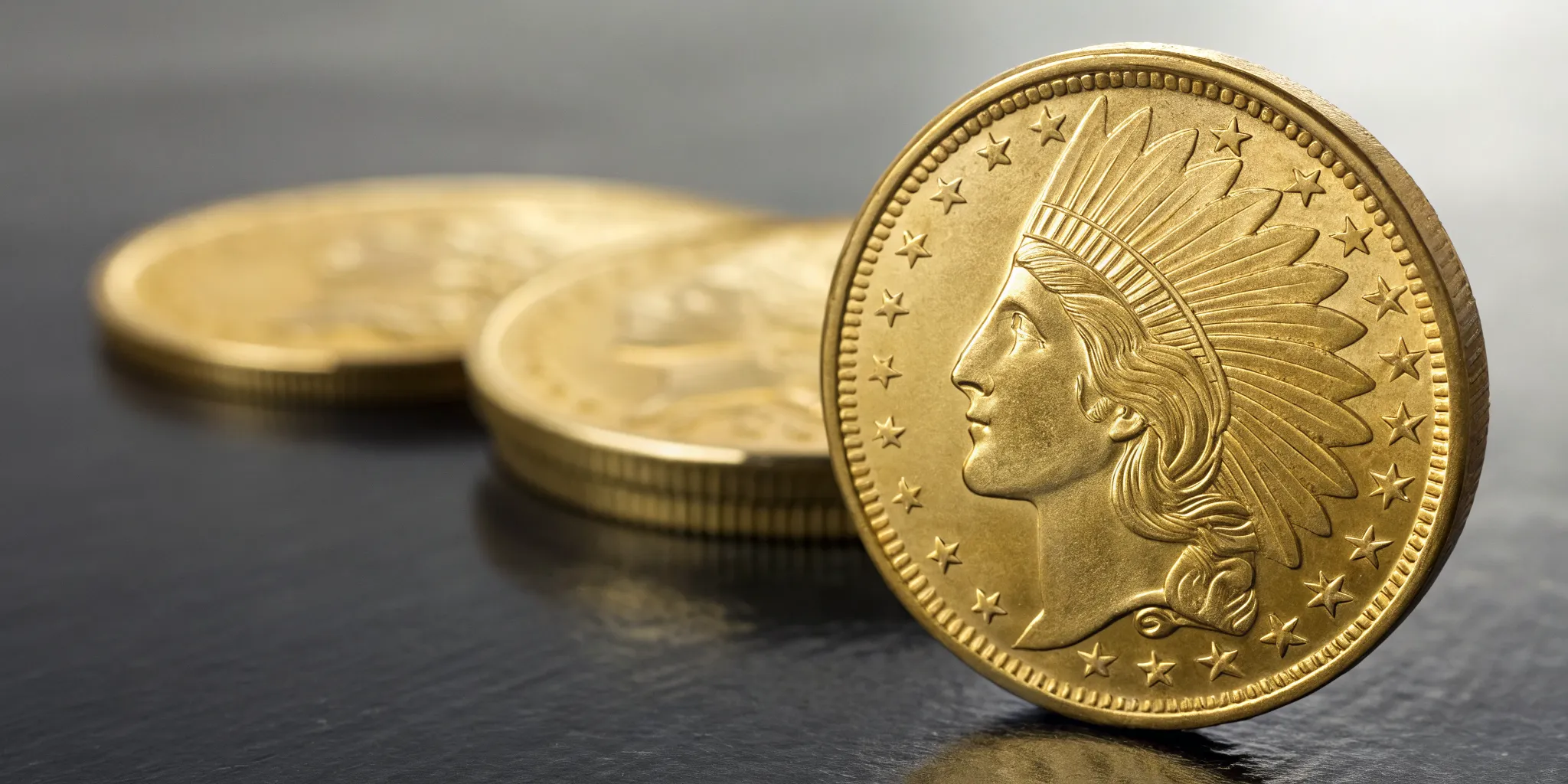
Some coins are more than just currency; they are tangible artifacts of a nation's most defining moments. The 1856-1889 Liberty Gold Dollar, Type 3, was minted during one of the most turbulent periods in American history, spanning the years before, during, and after the Civil War. Its production numbers tell a story of economic upheaval, with mintages plummeting during the conflict as citizens hoarded precious metals. Each coin from this era is a small piece of that history, from the common dates struck in times of peace to the legendary rarities produced at Southern mints on the brink of secession.
Key Takeaways
- A design born from necessity: The Type 3 Gold Dollar's "Large Head" design wasn't just for looks; it was a practical fix for the wear and striking issues that plagued earlier gold dollars. This successful redesign resulted in a more durable coin that retained its details through circulation.
- Historical context dictates value: A coin's rarity is often tied directly to its history. The Civil War, for example, caused extremely low mintages, making those dates highly valuable. Understanding these events helps you identify the most significant and sought-after coins in the series.
- Focus on quality and care: To build a strong collection, prioritize a coin's condition (grade) and rarity (key dates and mint marks). Partnering with a trusted dealer ensures authenticity, while proper storage is essential to preserve your coin's physical condition and long-term value.
What Is the Type 3 Liberty Gold Dollar?
The Type 3 Liberty Gold Dollar holds a special place in American numismatics as the third and final design of the nation's smallest gold coin. Struck from 1856 to 1889, this coin represents the culmination of efforts by the U.S. Mint to create a durable and practical gold dollar. Often called the "Large Head" Indian Princess, its design is not only beautiful but also tells a story of innovation and endurance through one of the most turbulent periods in U.S. history. For collectors, the Type 3 offers a perfect blend of historical significance, classic design, and accessibility.
A Brief History of America's Smallest Gold Coin
The Type 3 Gold Dollar enjoyed a long production run, minted continuously from 1856 until the series ended in 1889. This longevity makes it a fascinating series to collect, as it spans the years leading up to, during, and after the American Civil War. While it was produced for over three decades, mintages dropped significantly during the war years, making coins from that era particularly scarce. This historical context adds a layer of intrigue to the series, as each coin is a small artifact from a transformative time. Its status as the final gold dollar design makes it a cornerstone of many classic U.S. coin collections and one of the most popular rare coins for sale.
Key Features of the Type 3 Design
The Type 3 design was born out of necessity. Its predecessors, the Type 1 and Type 2 gold dollars, suffered from design flaws that made them wear down too quickly in circulation. The U.S. Mint’s solution was the "Large Head" motif. This updated design features a larger, flatter portrait of Liberty as an Indian Princess. This change allowed for a stronger, more even strike, resulting in a more durable coin with sharper details. You can easily spot a Type 3 by its prominent portrait, improved definition in Liberty’s headdress, and bold, clear lettering. This successful redesign is why well-preserved examples are more common than their Type 2 counterparts, making them a great entry point for those interested in classic gold bullion.
Specifications and Composition
Understanding the technical details of a Type 3 Gold Dollar is key to appreciating its value and authenticity. Each coin was struck from an alloy of 90% gold and 10% copper, a standard composition used to give the soft precious metal enough strength to withstand circulation. The coin has a weight of 1.7 grams and a diameter of 14.3 millimeters, making it the smallest gold coin in U.S. history. Its edge is reeded, which consists of small vertical grooves intended to prevent clipping or filing. These specifications are consistent across the entire series, and verifying them is a crucial first step in authentication. Working with a trusted dealer can give you confidence in your coin's authenticity and quality, a commitment we've stood by for over 35 years, as you can see in our company history.
How Does the Type 3 Compare to Earlier Designs?
To appreciate the Type 3 Gold Dollar, it helps to understand what came before it. The U.S. Mint’s first two attempts at a gold dollar coin had significant design flaws that limited their lifespan. The Type 3 wasn't just a new design; it was a practical solution born from the lessons of its predecessors. Each change made by Chief Engraver James B. Longacre was a direct response to the issues that plagued the Type 1 and Type 2 coins, ultimately creating a more durable and beautiful piece of currency.
The Problem with the Type 1 "Small Head"
The first gold dollar, the Type 1 "Small Head" (1849-1854), was tiny. At just 13 millimeters in diameter, it was easily lost. But its main problem was durability. The design featured a small bust of Liberty, and the relief was such that the highest points of the coin wore down very quickly in circulation. This meant that even moderately used coins lost their fine details, making it a challenge for collectors to find well-preserved examples. The coin’s small size and tendency to show wear made it clear that a new design was needed to create a more practical and lasting coin.
The Short-Lived Type 2 "Tall Head"
The Mint’s next attempt was the Type 2 "Indian Princess" (1854-1856). This coin was larger in diameter but thinner, and it introduced the iconic Indian Princess motif. Unfortunately, it had its own set of problems. The design had a very high relief, meaning the central features were raised significantly. This caused major issues during the striking process, especially at the branch mints. The pressure wasn't distributed evenly, resulting in coins with weak details. Often, the date and the word "DOLLAR" on the reverse were barely visible. This fundamental flaw meant the Type 2 design was quickly abandoned after only two years.
Why the Type 3 Design Succeeded
The Type 3 "Large Head" Gold Dollar (1856-1889) finally got it right. Longacre modified the Type 2 design by creating a larger, flatter portrait of the Indian Princess. He also lowered the overall relief and adjusted the placement of the head so it wouldn't clash with the design on the reverse. These changes allowed the coin to strike up fully and evenly, capturing all the intended details. The result was a much more durable coin that held up well in circulation. This successful design remained in production for over 30 years, making it one of the most accessible classic gold coins for sale for today’s collectors.
What History Shaped the Type 3 Gold Dollar?
Every coin tells a story, and the Type 3 Gold Dollar is a direct reflection of a pivotal and turbulent era in American history. Its production run from 1856 to 1889 coincided with the Civil War and the significant economic changes that followed. Understanding this historical backdrop is key to appreciating why certain dates are so rare and why the coin was eventually discontinued. The war, the division of the country, and the ultimate shift in economic policy all left their mark on this tiny piece of gold, turning it from simple currency into a tangible piece of history.
The Civil War's Impact on Minting
The outbreak of the Civil War in 1861 had an immediate and dramatic effect on the minting of all U.S. coins, especially those made of precious metals. As the nation split, resources were funneled into the war effort, and economic instability led citizens to hoard gold and silver. Consequently, the production of Type 3 Gold Dollars plummeted. Mintages during and immediately after the war were exceptionally low, particularly at the Philadelphia Mint. This scarcity makes Civil War-era gold dollars highly prized by collectors. Finding one of these rare coins for sale offers a direct connection to a defining moment in the nation's past.
The Dahlonega Mint and Confederate Coins
The story of the Southern branch mints adds another layer of intrigue. The U.S. Mints in Charlotte, North Carolina, and Dahlonega, Georgia, were located in states that seceded from the Union. In 1861, both facilities were seized by the Confederacy. Before their operations ceased, the Dahlonega Mint managed to strike a very small number of gold dollars. These 1861-D gold dollars are legendary among collectors, as they represent the final U.S. coins struck at the facility before it fell into Confederate hands. This unique historical context makes the 1861-D one of the most sought-after and valuable coins in the entire series, a true prize for any serious numismatist.
Economic Shifts That Ended the Gold Standard
While the Civil War defined the middle of its run, broad economic changes brought the Type 3 Gold Dollar's production to an end. The coin was officially discontinued in 1889. Although it was no longer being minted, it continued to circulate for years. The final chapter for circulating gold coinage came when the United States eventually abandoned the gold standard. This major policy shift meant that gold was no longer used for everyday transactions, making small-denomination coins like the gold dollar obsolete. While its time as currency was over, its legacy as a store of value continues, much like modern investors rely on gold bullion today.
Key Dates and Varieties for Collectors
When you start collecting Type 3 Gold Dollars, you'll quickly learn that not all coins are created equal. Certain dates, mint marks, and subtle design variations can make a coin exceptionally rare and valuable. Knowing which ones to look for is key to building a significant collection. These special coins are often called "key dates" because they are essential to completing a high-quality set. Here are a few of the most important dates and varieties to keep on your radar as you search for your next piece.
The Legendary 1861-D Confederate Coin
The 1861-D is one of the most fascinating coins in American history. Struck at the Dahlonega Mint in Georgia, these coins were produced after Confederate forces seized the facility at the start of the Civil War. While the exact mintage is unknown due to poor record-keeping during the conflict, it's estimated that only a very small number were ever made. This historical context, combined with its extreme rarity, makes the 1861-D a true prize. For many, owning this coin is like holding a tangible piece of Civil War history, making it a cornerstone of many advanced rare coin collections.
Rare Low-Mintage Dates to Look For
Beyond the storied 1861-D, several other Type 3 Gold Dollars are highly sought after due to their incredibly low production numbers. The 1875 gold dollar is a prime example, with a minuscule mintage of just 400 business strikes. This makes it one of the rarest dates in the entire series. Other key dates with low mintages include 1863, 1879, 1880, and 1881. When a coin has a low mintage, its survival rate in high grades is even lower, driving up its rarity and value. You can explore mintage figures for US coins to better understand the scarcity of specific dates.
The "Closed 3" Variety and Proof Coins
Sometimes, a coin's value lies in a tiny detail. In 1863, the U.S. Mint produced two versions of the Type 3 Gold Dollar: one with an "Open 3" in the date and another with a "Closed 3," where the top and bottom of the number are much closer together. The "Closed 3" is the rarer of the two and is highly prized by variety collectors. What makes it even more interesting is that all proof coins struck in 1863 feature the "Closed 3" design. These proof issues are exceptionally rare and represent the pinnacle of quality for that year. Paying close attention to these numismatic varieties can help you spot a valuable coin that others might overlook.
How to Determine Your Type 3 Gold Dollar's Value
Figuring out what your Type 3 Gold Dollar is worth involves more than its gold content. A coin’s history, condition, and rarity play a huge role in its final value. While a common coin might be worth its melt value, a rare date in pristine condition could be worth thousands. To get an accurate picture, you need to examine its grade, identify its mint mark and date, and understand the current market.
Assess Your Coin's Grade and Condition
A coin's physical condition, or 'grade,' is one of the most important factors in its value. A coin with no signs of wear is considered 'Mint State' and is worth far more than a heavily worn one. Many Indian Head Type 3 Gold Dollars are especially rare in top condition. Special 'proof' coins, struck for collectors with a mirror-like finish, are also highly sought after. Getting an accurate grade is crucial, which is why many collectors rely on expert appraisal services to understand a coin's true quality and market value.
Understand Mint Marks and Rarity
Next, check the coin's date and mint mark. The mint mark, a small letter, tells you where it was made, and some mints produced far fewer coins than others. For example, over 1.7 million Type 3 dollars were struck in 1856, but only 400 were made in 1875, making it one of the rarest business strikes in U.S. history. Certain dates are particularly valuable, like the 1858-D, 1861-D, and 1889 issues. Also look for unique varieties, like the 'Upright 5' on some 1856 coins. You can browse collections of rare coins for sale to see how these factors affect pricing.
Consider Market Demand and Authentication
Finally, collector demand influences a coin's value. The Type 3 Gold Dollar was produced until 1889 and circulated until the U.S. left the gold standard in the 1930s, giving it a rich history. Because some dates and proof versions are so rare, authentication is essential. A certified coin from a reputable grading service provides peace of mind and ensures you're getting a genuine piece. The market for authenticated, high-grade coins is consistently strong, and working with a trusted dealer ensures you are buying or selling at a fair market price.
How to Start Your Type 3 Collection
Jumping into a new collection is exciting, and the Type 3 Liberty Gold Dollar is a fantastic series to explore. With a bit of planning, you can build a collection that you’re proud of. The key is to approach it thoughtfully by defining your goals, finding a trustworthy partner, and committing to proper care from day one. These steps will help you get started on the right foot and enjoy the process of acquiring these beautiful pieces of American history.
Set Your Collection Goals and Budget
Before you buy your first coin, take a moment to think about what you want to achieve. Are you hoping to assemble a complete date set, or would you prefer to focus on high-grade examples from specific mints? The Type 3 Gold Dollar was minted from 1856 to 1889, offering plenty of variety. Defining your focus helps you create a clear roadmap and a realistic budget. You might decide to collect one coin from each decade or seek out pieces with unique historical significance. Whatever your goal, establishing it early will make your search more focused and rewarding.
Find a Reputable Dealer
Your collection is an investment, so it’s essential to work with someone you trust. A reputable dealer is your most important partner in the world of numismatics. They not only provide access to authentic, accurately graded coins but also offer invaluable expertise. Look for dealers with a long history in the industry and a solid reputation. When you find a dealer who specializes in gold coins, you can feel confident that you’re getting a quality piece for your collection. This partnership will help you avoid counterfeits and make informed purchasing decisions as you grow your collection.
Store and Handle Your Coins with Care
Proper storage is crucial for preserving the condition and value of your Type 3 Gold Dollars. While these coins were designed to be more durable than earlier types, they are still susceptible to damage from improper handling and environmental factors. Always hold your coins by their edges to avoid leaving fingerprints on the surface. For long-term storage, use inert, acid-free holders or slabs to protect them from scratches and exposure to the air. Storing your collection in a cool, dry place with a stable temperature, like a safe or a dedicated cabinet, will ensure your coins remain in beautiful condition for years to come.
Related Articles
- Type 1 Liberty Gold Dollar
- THE THREE DOLLARS GOLD (1854-1889)
- LIBERTY SEATED DOLLARS WITH MOTTO (1866-73)
- LIBERTY SEATED DOLLARS, NO MOTTO (1840-65)
Frequently Asked Questions
Why is it called the "Indian Princess" head if the figure is supposed to be Liberty? That's a great question that points to a common piece of numismatic trivia. The designer, James B. Longacre, modeled the portrait after a classical Greco-Roman statue but added a feathered headdress. At the time, this headdress was a popular artistic symbol used to represent America, not a specific Native American person. So, while collectors have called it the "Indian Princess" for generations, the figure was always intended to be an allegorical representation of Lady Liberty.
What's the easiest way to tell the difference between the Type 1, 2, and 3 gold dollars? The quickest way to distinguish them is by looking at the size and the portrait. The Type 1 is noticeably smaller than the other two. If your coin is the larger size, compare the heads. The Type 2 has a taller, more delicate-looking portrait, while the Type 3 features a much larger and flatter head. This "Large Head" design of the Type 3 was the final, successful version that solved the striking issues of the earlier types.
Where can I find the mint mark on my Type 3 Gold Dollar? You can find the mint mark on the reverse side of the coin, which is the side with the date and wreath. Look directly below the bow at the bottom of the wreath. You might see a small "C" for Charlotte, "D" for Dahlonega, or "S" for San Francisco. If your coin has no letter in that spot, it was produced at the main U.S. Mint in Philadelphia, which did not use a mint mark on its coins during this period.
Are all Type 3 Gold Dollars valuable just because they're old and made of gold? While every coin has a base value from its gold content, its collector value is a different story. A common date in heavily circulated condition might not be worth much more than its weight in gold. The truly valuable coins are those with key dates, low mintages, or exceptional grades. A rare date like the 1875 issue or a coin in pristine, uncirculated condition can be worth thousands of times its gold value. Rarity and condition are the most important factors.
What is the difference between a "business strike" and a "proof" coin? A business strike is a standard coin produced for general circulation and everyday use. A proof coin, however, is a special version made specifically for collectors. Proofs are struck multiple times with specially polished dies on polished coin blanks. This process creates a coin with incredibly sharp details, a frosted design, and a mirror-like background. They were made in very small quantities and are much rarer than their business strike counterparts.





