
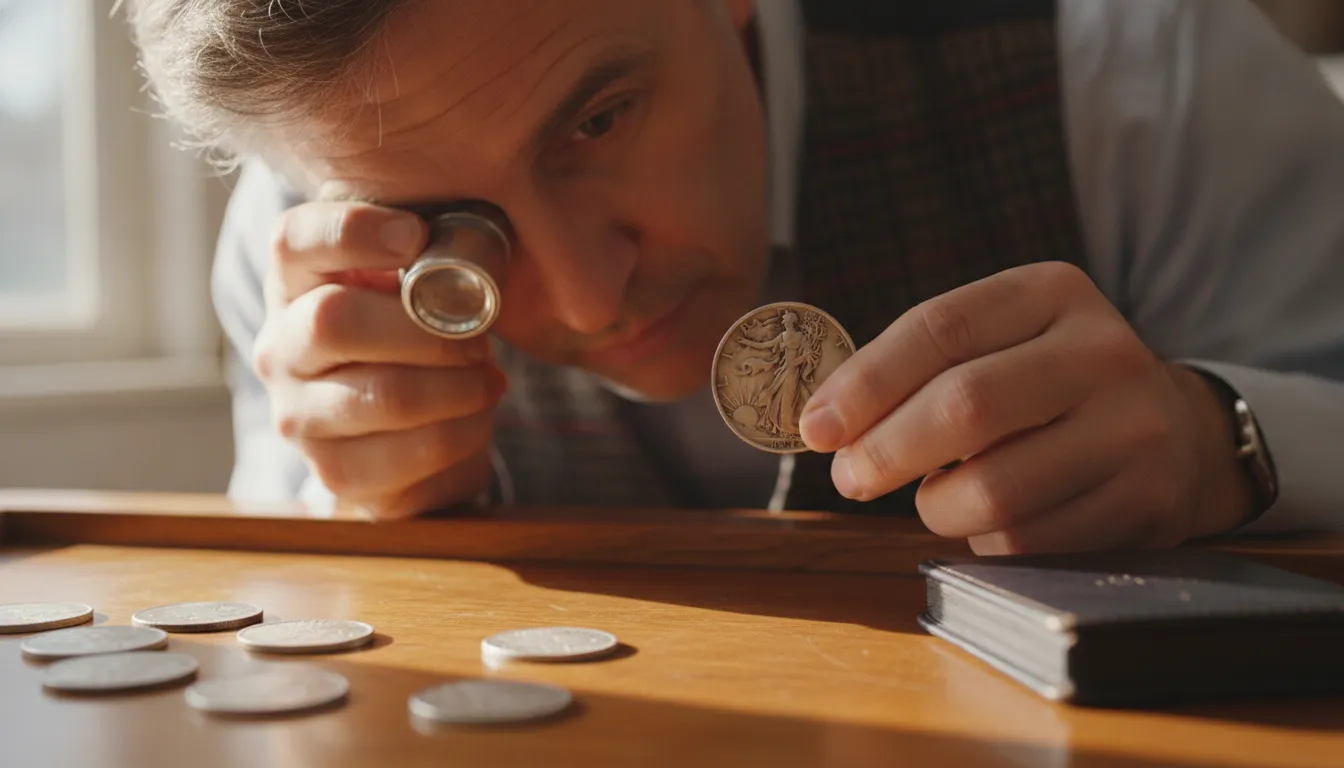
When a seller or collector uses this informal silver-dollar label, the name can create an immediate question: was there ever a U.S. dollar coin with that exact designation? The answer matters because the term may refer to a classic half dollar, a modern bullion coin, or a collectible described informally.
The U.S. Mint never issued a circulating coin formally called the walking liberty silver dollar. The Walking Liberty design belongs to the 50-cent Walking Liberty Half Dollar, struck from 1916 through 1947. And to a modified form used on the American Silver Eagle beginning in 1986.
Adolph A. Weinman's design is recognizable for Liberty moving toward a rising sun with olive branches, but the coins carrying it differ in denomination, silver content, purpose, and collector context. Understanding those distinctions helps you identify what you own or are considering before you compare mintage, condition, and market value.
Call 1-888-419-7136 to speak with a Park Avenue Account Specialist about your Walking Liberty coins.
What Is the Walking Liberty Silver Dollar?
If you search for a walking liberty silver dollar, you may expect to find a vintage U.S. dollar coin with that official name. The U.S. Mint never struck a circulating, face-value silver dollar formally called the Walking Liberty dollar. The name is a common collector shorthand that usually points to the Walking Liberty half dollar, a 50-cent silver coin issued from 1916 through 1947.
That distinction matters when you are identifying a coin, comparing its specifications, or asking about its value. The Walking Liberty half dollar was designed by Adolph A. Weinman in 1916 and is recognized as an important example of early 20th-century Beaux-Arts medallic design. On the obverse, Liberty strides toward a rising sun while carrying olive branches. The reverse shows an eagle with rising wings. The U.S. Commission of Fine Arts documents the design and its history in its overview of the Walking Liberty half dollar.
Why do collectors use "silver dollar"?
Several related coins and designs create the confusion. First, the half dollar contains silver, but its denomination is 50 cents, not one dollar. It is composed of 90% silver and 10% copper, with approximately 0.36169 troy ounces of silver. You can review examples of the series in Park Avenue Numismatics' collection of Walking Liberty Half Dollars.
Second, the American Silver Eagle uses a modified version of Weinman's Walking Liberty obverse. The Silver Eagle is a one-troy-ounce bullion coin, not the vintage circulating half dollar and not a historical circulating silver dollar. When someone uses the informal phrase, context tells you whether they mean a Walking Liberty half dollar. An American Silver Eagle, or another modern product inspired by the design.
How should you identify the coin?
Start with the denomination, date, and type rather than the nickname. Follow a quick three-step check to place any coin you are examining:
- A 1916-1947 coin with the Walking Liberty design is a half dollar, not a dollar coin.
- A modern one-ounce bullion coin with the same familiar obverse is an American Silver Eagle.
- Any other product using similar imagery is a modern or privately issued round inspired by the design.
This simple check helps you research the correct series, understand its silver content, and seek an appropriate assessment from a knowledgeable numismatic professional.
Walking Liberty Design: Weinman's Beaux-Arts Masterpiece
When you study the Walking Liberty half dollar, you are looking at more than an attractive silver coin. Adolph A. Weinman designed it in 1916, and the result is widely regarded as an exemplar of early 20th-century Beaux-Arts medallic art. Its appeal comes from the way the design communicates movement, purpose, and optimism within the compact space of a circulating coin.
Design philosophy: Weinman treated Liberty as an active figure rather than a static emblem. She strides forward with olive branches in her hands, moving toward a rising sun. The composition suggests peace and progress, while the flowing garment and advancing posture give the obverse an unusual sense of motion. You can review the U.S. Commission of Fine Arts' detailed history of the Walking Liberty half dollar design for the official discussion of Weinman's work and its Beaux-Arts significance.
Obverse symbolism: The olive branches reinforce Liberty's association with peace, but the image does not feel passive. Her forward stride creates a visual narrative that rewards close examination. As a collector, you can appreciate how the sun, branches, clothing, and lettering work together without making the coin feel crowded. Even after years of handling, the basic silhouette remains immediately recognizable.
Reverse balance: The reverse presents an eagle with rising wings, clutching a pine tree branch. That choice gives the design a distinctly American counterpoint to the obverse. The eagle conveys strength and independence, while the branch adds a natural element that keeps the composition from becoming overly severe. The two sides therefore complement each other: Liberty advances toward a brighter horizon, and the eagle rises with controlled energy.
Enduring appeal: You can understand why this remains one of the most loved American coin designs. It combines classical artistic influence with symbols that feel direct and legible, even to someone seeing the coin for the first time. The design is also adaptable. A modified version of Weinman's obverse later appeared on the American Silver Eagle, extending its visual legacy to a new generation of collectors and bullion buyers. Whether you collect vintage half dollars for their history, artistry, or condition, the Walking Liberty design gives you several meaningful ways to engage with the coin.
Walking Liberty Half Dollar Mintage and Specifications
The Walking Liberty half dollar was struck by the United States Mint from 1916 through 1947. Although collectors sometimes call it a "walking liberty silver dollar," the original coin is a 50-cent half dollar, not a dollar denomination. Its specifications explain why it remains important to both traditional coin collectors and buyers interested in 90% silver coinage.
Silver Content of the Walking Liberty Half Dollar
Composition: The coin contains 90% silver and 10% copper. Its approximate actual silver weight is 0.36169 troy ounce, a useful figure when comparing the coin with other silver products. This silver content reflects the coin's original composition and should not be confused with the amount of silver in a modern bullion coin. Park Avenue Numismatics carries this 90% silver coinage for buyers seeking pre-1965 silver content.
Mass: A standard Walking Liberty half dollar weighs 12.50 grams. Diameter: It measures 30.63 millimeters across. Wear, damage, cleaning, or alterations can affect how an individual example looks and weighs, so specifications are only one part of a proper evaluation.
| Specification | Walking Liberty half dollar | American Silver Eagle |
|---|---|---|
| Denomination or product type | 50-cent circulating coin. | Modern bullion coin. |
| Silver composition | 90% silver, 10% copper. | 1 troy oz, 99.9% pure silver. |
| Silver weight or mass | 0.36169 troy oz silver; 12.50 g mass. | 1 troy oz (31.1 g). |
| Diameter | 30.63 mm. | 40.6 mm. |
| Production period | 1916-1947. | 1986 to present. |
Since 1986, a modified version of Adolph A. Weinman's Walking Liberty obverse has appeared on the American Silver Eagle. That connection explains much of the modern "silver dollar" terminology. But the two coins serve different purposes: the vintage Walker is a historic half dollar, while the Silver Eagle is a modern bullion issue. For the vintage coin, date, mintmark, condition, and originality can matter as much as silver content. See Walking Liberty half dollars to review collector examples, and browse our rare half dollars for other series.
Specifications sourced from the Walking Liberty half dollar reference.
How the Walking Liberty Design Became the American Silver Eagle
When you see Liberty striding toward the rising sun on a modern American Silver Eagle, you are seeing a direct descendant of Adolph A. Weinman's celebrated Walking Liberty design. The U.S. Mint introduced the American Silver Eagle in 1986 with a modified version of Weinman's obverse, bringing a 1916 artistic landmark into a modern bullion program. The original design features Liberty carrying olive branches, while the vintage half dollar's reverse shows an eagle with rising wings and a pine branch. The design history is documented by the Commission of Fine Arts.
That connection explains why shoppers sometimes search for a "Walking Liberty silver dollar" in online listings. However, the phrase can describe two very different coins, and neither should be confused with a circulating U.S. silver dollar named Walking Liberty.
Walking Liberty Half Dollar vs. American Silver Eagle
- Walking Liberty half dollar: This is a vintage 50-cent coin struck by the United States Mint from 1916 through 1947. It is composed of 90% silver and 10% copper, contains approximately 0.36169 troy ounces of silver, and weighs 12.50 grams. Its denomination is one-half dollar, not one dollar. See the Walking Liberty half dollar specifications and history.
- American Silver Eagle: This is a modern one-troy-ounce bullion coin containing 99.9% silver. Its obverse uses a modified Walking Liberty image, but the coin belongs to the Silver Eagle program rather than the vintage half-dollar series.
The distinction matters when you buy or sell. A vintage Walker is evaluated as a collectible coin, with date, mintmark, condition, and variety influencing collector interest. An American Silver Eagle is generally identified by its one-ounce bullion content, year, condition, and issue type. Both are silver coins, but they serve different collecting and ownership purposes.
If someone offers you a "Walking Liberty silver dollar," ask for the exact denomination and specifications before agreeing to a purchase. You may be looking at a Walking Liberty half dollar, an American Silver Eagle, or a privately issued round using similar language. Confirming the date, weight, purity, and certification can prevent an expensive misunderstanding.
What to Look For In a Walking Liberty Silver Dollar and Half Dollar
When you evaluate a Walking Liberty coin, look beyond its silver content. A coin's appeal can reflect condition, date, mint mark, variety, and the confidence that its grade and authenticity have been properly assessed. The term "Walking Liberty silver dollar" is often used informally, but the vintage coin collectors usually mean is the Walking Liberty half dollar, issued from 1916 through 1947.
Authenticating and Grading Your Walking Liberty Coin
Preservation: Well-preserved examples are among the most sought after because original luster and sharp detail are difficult to retain. That is especially true on a coin that is more than seven decades old. Examine Liberty's gown, hair, hand, and the rising sun, along with the eagle and surrounding lettering on the reverse. Heavy wear, cleaning, scratches, or damage can materially change how collectors view the piece.
Date and mint mark: Some dates and mint-issued variations attract more attention because availability differs across the series. Multiple types or varieties were produced in some years, so identifying the exact issue matters before you compare examples or assess collector interest. If you own several pieces, record the date, mint mark, visible variety features, and condition separately rather than treating the group as interchangeable.
Silver content: A vintage Walking Liberty half dollar contains 90% silver and approximately 0.36169 troy ounces of silver. That intrinsic content can provide a baseline tied to the market for silver, but it does not establish a guaranteed selling price. Depending on condition, rarity, date, mint mark, and variety, values can range from silver melt value to thousands of dollars for rare, high-grade specimens. Market conditions and buyer demand remain important.
Third-party certification: PCGS and NGC encapsulate eligible coins and assign an independent grade after authentication and examination. A respected certification can make a coin's condition easier for buyers to compare and may support liquidity. Although it does not eliminate market risk or guarantee a particular result. For an overview of available Walking Liberty half dollars, compare the coin's holder, label, date, mint mark, and listed grade with the actual surfaces.
Before cleaning, polishing, or altering a coin, seek an expert opinion. Surface changes can remove original characteristics that collectors value. A specialist can help distinguish ordinary wear from a scarce issue and explain how the market typically evaluates the specific coin in front of you.
Frequently Asked Questions
Is there a Walking Liberty silver dollar?
No. The U.S. Mint did not issue a circulating coin formally called a Walking Liberty silver dollar. The familiar Weinman design appears on the Walking Liberty half dollar, a 50-cent coin produced from 1916 through 1947. The modern American Silver Eagle uses a modified version of the same obverse, which is why the terms are sometimes confused. Learn more about the Walking Liberty half dollar.
What is the difference between a Walking Liberty half dollar and an American Silver Eagle?
The vintage half dollar is a 90% silver, 10% copper U.S. coin with a 50-cent face value. The American Silver Eagle, introduced in 1986, is a modern one-troy-ounce bullion coin that uses a modified Walking Liberty obverse. They share a design heritage, but they are different coins with different specifications and collecting purposes. Review the design history and specifications.
Who designed the Walking Liberty coin design?
Adolph A. Weinman designed the Walking Liberty half dollar in 1916. Its obverse shows Liberty moving toward a rising sun while carrying branches, and the reverse shows an eagle with rising wings. The Commission of Fine Arts describes the coin as an exemplar of early 20th-century Beaux-Arts medallic design. See the Commission of Fine Arts overview.
How much silver is in a Walking Liberty half dollar?
A standard Walking Liberty half dollar contains approximately 0.36169 troy ounces of pure silver. Its total composition is 90% silver and 10% copper, with a mass of 12.50 grams. That silver content provides a baseline, while date, mint mark, condition, and collector demand determine whether a particular coin carries a substantial numismatic premium. Check the technical specifications.
How can you tell whether a Walking Liberty coin is valuable?
Start with the date, mint mark, condition, and authenticity. Rare varieties and well-preserved examples can be worth far more than their silver content, while worn or common pieces may trade closer to melt value. For an important coin, professional authentication and grading from PCGS or NGC can help establish condition and marketability before you sell or add it to a collection.
Ready to Discuss Your Walking Liberty Coins?
If you are buying or selling Walking Liberty half dollars, American Silver Eagles, or other collectible silver, a knowledgeable review can help you understand what you have. That assessment makes it easier to choose the buying or selling options that best fit your goals. Speak with a Park Avenue Account Specialist for guidance tailored to your collection, or visit our Miami showroom at 5084 Biscayne Blvd, Suite 105. Call 1-888-419-7136 to speak with our team about your next step.





