
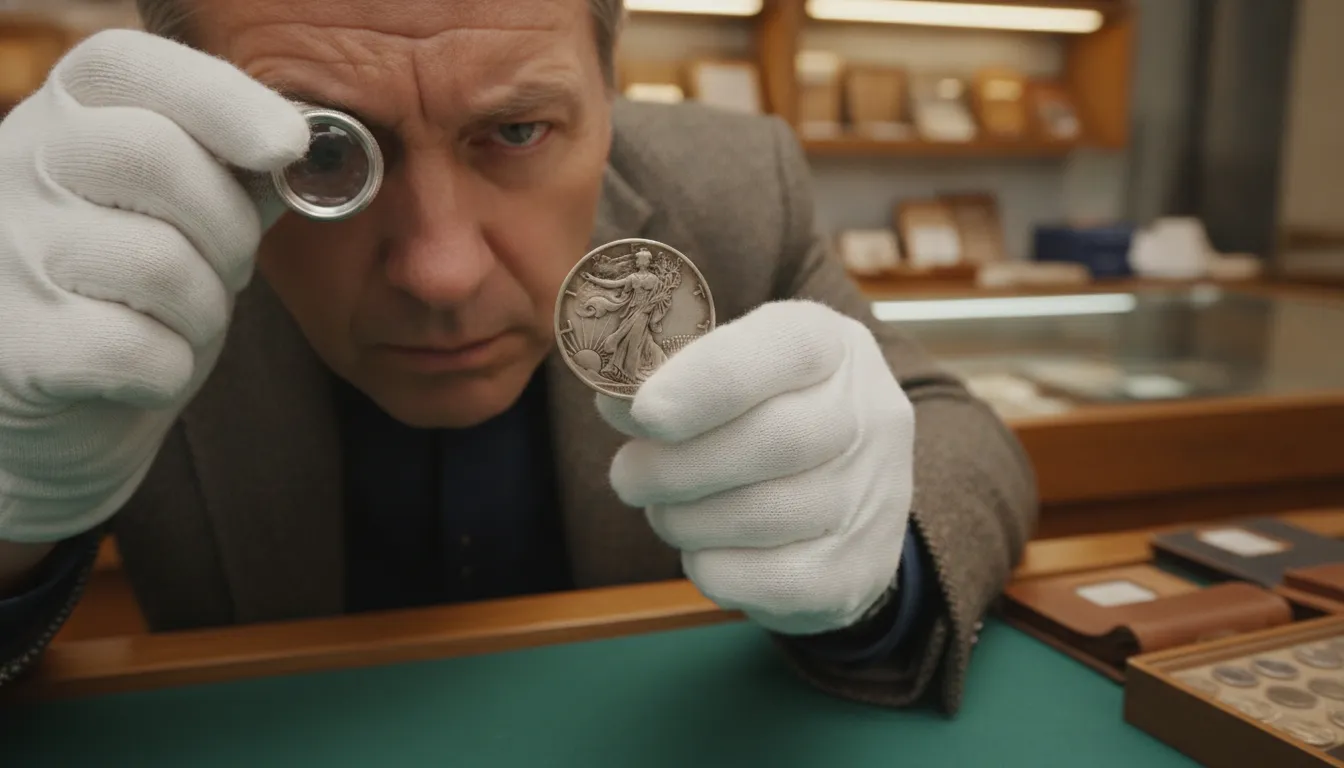
If you are holding a 1916-1947 Walking Liberty half dollar, you have more than an old silver coin. You are looking at one of the most admired designs in American coinage, a series shaped by changing mintages, scarce dates, striking quality, and decades of collector demand.
The walking liberty half dollar was minted from 1916 through 1947 and contains 90% silver and 10% copper. Its value as a collectible depends on the date, mint mark, condition, strike, and originality, while its design gives the series lasting appeal beyond its metal content.
Call 1-888-419-7136 to speak with a Park Avenue Account Specialist about buying a Walking Liberty half dollar or getting your coins appraised at our Miami store on Biscayne Blvd.
Before you compare key dates or evaluate a coin's grade, it helps to understand why the U.S. Mint introduced this half dollar and what its imagery was meant to convey. That foundation makes the series easier to collect with purpose, whether you are building a date-and-mint set or studying a single memorable example.
The History of the Walking Liberty Half Dollar
Imagine receiving a half dollar in 1916 and seeing Liberty moving forward rather than sitting in a formal portrait. That change reflected a broader effort to give American coinage a more modern, distinctly artistic character, and it created one of the most recognizable designs in U.S. numismatics.
The Walking Liberty Half Dollar was minted from 1916 through 1947, according to the United States Mint. It replaced the Barber half dollar, whose design had represented an earlier era of American circulation. For you as a collector. That transition gives the series a clear historical starting point: the first issues belong to the period when the Mint was deliberately refreshing the look and symbolism of everyday coins.
A new design selected through competition
The coin's origin reaches back to a 1915 competition organized by the U.S. Mint. Sculptor Adolph A. Weinman submitted the designs that were chosen for the new half dollar. Weinman was a pupil of Augustus Saint-Gaudens and Philip Martiny, placing the coin within the tradition of ambitious American sculpture as well as practical coin design.
That background helps explain why the Walking Liberty Half Dollar feels more like a small work of art than a routine piece of change. The obverse presents Liberty walking toward the dawn, a composition associated with hope and forward progress. The reverse shows an American bald eagle standing on a mountain crag. When you examine an early example, you are looking at a design intended to carry national ideals into daily commerce, not merely identify a denomination.
A series that endured through wartime
The series continued through major changes in American life. During World War II, intense demand for circulating coins kept the mints producing Walking Liberty Half Dollars continuously from 1941 through 1945. Those wartime issues connect an otherwise familiar collecting series to the economic demands and industrial activity of the period.
The design concluded its run in 1947. In 1948, the Franklin Half Dollar succeeded it, marking the end of more than three decades of the Walking Liberty type. Even after the original series ended, the design remained influential. The United States Mint later revived the obverse for the American Silver Eagle beginning in 1986, allowing a new generation to recognize its central image.
As you build a collection, keep that timeline in view. Each date is part of a continuous story that begins with the 1915 competition. Spans the 1916-1947 minting period, and preserves the visual language of an important chapter in American coinage.
The Design That Made the Walking Liberty Half Dollar Famous
Look closely at the obverse and you see more than a portrait of Liberty. You see a figure moving into the light, with the rising sun behind her and the American flag gathered around her shoulders. The design was created by sculptor Adolph A. Weinman, whose work helped define the Renaissance of American Coinage. The Commission of Fine Arts describes the design as one of the most beautiful in U.S. numismatic history.
An obverse built around movement and hope
Lady Liberty strides toward the rising sun, carrying branches in one hand while her other hand draws the flag close. Her forward motion gives the coin an unusual sense of purpose. She is not posed rigidly or enclosed in a formal bust. Instead, she appears to be advancing toward a new day, an image that symbolized national hope and forward progress.
The obverse also carries the legends LIBERTY and IN GOD WE TRUST, along with the date. Those words frame the figure without overwhelming the composition. On a well-preserved example, you can study the folds of the skirt, the texture of the flag. And the rays of the emerging sun as separate design elements that work together as one scene.
Weinman's artistic background helps explain the design's sculptural quality. The Smithsonian American Art Museum identifies him as a student of Augustus Saint-Gaudens, one of America's most influential sculptors. Researchers also widely identify Audrey Munson as the model for Weinman's Liberty. You can read the National Numismatic Collection's overview for additional context on the model and the series.
A reverse that balances strength with space
Turn the coin over and the composition changes from a walking figure to an American bald eagle with its wings spread, standing on a mountain crag. The eagle gives the reverse a firm, elevated presence, while the open space around the wings keeps the image from feeling crowded. The rocky perch adds a natural setting rather than reducing the eagle to a simple emblem.
Weinman's initials, AW, appear on the reverse near the eagle's tail. They are easy to overlook on a circulated coin. But finding them adds another small point of connection between the object in your hand and the artist who made it. The coin's 90 percent silver and 10 percent copper composition also gave the sculptural design the durability needed for everyday circulation, according to the U.S. Mint.
Why the design still matters
The Walking Liberty Half Dollar became a lasting design because its symbolism remained readable even at a small scale. In 1986, the U.S. Mint revived the Liberty image on the obverse of the American Silver Eagle, introducing Weinman's work to a new generation of collectors. When you compare the two coins, you can see how an early 20th-century circulating design continued to represent American ideals in a modern bullion series.
That combination of movement, symbolism, and sculptural detail is why collectors study the design as carefully as the date and mint mark. It is also why a Walking Liberty Half Dollar can appeal to you as both a historic U.S. coin and a work of medallic art.
How Much Is a Walking Liberty Half Dollar Worth?
If you are evaluating a Walking Liberty Half Dollar, start by separating its silver value from its collector value. There is no single price that applies to every coin. Date, mint mark, condition, strike quality, eye appeal, and originality can move one example far above another that looks similar at a glance.
The ranges below are illustrative categories, not price predictions or financial advice. For a current estimate, compare the exact date and mint mark with the PCGS Walking Liberty Half Dollar price guide. Have the coin examined in person when condition or authenticity is uncertain. Past performance is no guarantee of future results.
| Example category. | Illustrative value range. | What usually drives the difference. |
|---|---|---|
| Common circulated issue. | Silver value to a modest collector premium. | Common dates may trade primarily as 90% silver, while a clean, original example can bring additional interest. |
| Key-date issue, especially 1921-D or 1921-S. | Substantial premium above ordinary circulated examples. | The 1921 issues are key dates, and 1921-D and 1921-S are particularly scarce and difficult to find in high grades. |
| High-grade or full-strike example. | Premium level determined by certified grade and market demand. | Sharp skirt lines, clear eagle feathers, attractive surfaces, and strong preservation can make the coin more desirable. |
Why the date and mint mark matter
Most collectors do not evaluate the series by silver content alone. They build sets by date and mint mark, which makes a scarce combination more important than a common coin from the same year. PCGS identifies the 1921, 1921-D, and 1921-S issues as notably scarce, with the Denver and San Francisco issues especially challenging in higher grades. Before you assign a value, confirm the date and look for the mint mark. A small identification error can produce a very different comparison.
Why condition can change the comparison
Strike quality matters throughout the series. Collectors often seek full-strike pieces with clear detail on Liberty's skirt and the eagle's feathers. Those details can be weak even when the coin has limited wear, so a simple glance at the date is not enough. Earlier issues may show more variation in striking quality, while later issues generally have more consistent strikes. PCGS and NGC third-party grading can help authenticate and describe a high-value coin. But certification does not eliminate the need to compare the correct date, mint mark, and grade.
The series also serves different collecting goals. The U.S. Mint notes that these coins have both bullion and numismatic appeal, while PCGS describes them as a staple of junk-silver investing. If you want a manageable collecting target rather than a complete 1916-1947 set, a 1941-1947 short set is a popular and generally more accessible route. Treat every quoted figure as a point-in-time indication, not a guarantee. A qualified specialist can help you distinguish a common silver coin from a scarce, well-preserved example.
Walking Liberty Half Dollar Silver Content and Melt Value
When you examine a Walking Liberty Half Dollar as a silver coin, its composition gives you a clear starting point. The United States Mint identifies the issue as 90 percent silver and 10 percent copper. That alloy was standard for the denomination during its circulating years and explains why these half dollars remain relevant to both collectors and people evaluating pre-1965 U.S. silver.
Each coin contains approximately 0.3617 troy ounces of pure silver, according to the U.S. Mint. This is the coin's approximate silver content, not necessarily the amount you should expect to recover if the piece is melted. Wear, handling, surface damage, and normal differences in condition can affect the coin's actual weight. For a collector, those details matter because a Walking Liberty half dollar can carry interest beyond its metal value.
What the silver composition tells you
The 90-percent silver and 10-percent copper alloy provides the composition floor for a common example. To estimate its general melt value, you look at the current market price of silver and apply it to the coin's approximate 0.3617 troy ounces of pure silver. Because silver prices change, melt value changes with them. A single calculation is therefore a snapshot, not a permanent price or a prediction.
This distinction helps you avoid confusing bullion value with collector value. A heavily circulated, common-date coin may be evaluated primarily for its silver content. A better-preserved example, a scarce date, or a coin with strong design details may deserve separate numismatic consideration. The silver value remains a useful baseline, but it does not replace an examination of the date, mint mark, grade, and surfaces.
Walking Liberty Half Dollars are also a staple of bags marketed as "junk silver," a term used for circulated silver coins valued mainly for their metal content. PCGS identifies the series as popular in that context, while the U.S. Mint's composition and weight information provide the practical reference points. Do not assume that every coin in a mixed bag has identical collector potential. Sort the coins by date and mint mark before treating the group as ordinary silver.
If you are comparing a group of coins, record each date, mint mark, and visible condition separately. That simple habit can keep a collectible piece from being valued only as scrap. For a detailed explanation of broader silver calculations, use a dedicated silver content guide. Then return to the individual coin's numismatic features before making a buying or selling decision.
Sources: U.S. Mint half dollar specifications and PCGS Walking Liberty Half Dollar market reference.
Grading a Walking Liberty Half Dollar with PCGS and NGC
Condition is the single most important value factor for a collectible Walking Liberty half dollar. Before you focus on a date, mint mark, or design detail, determine whether the coin is authentic and how much original detail it retains. Professional third-party grading services, including PCGS and NGC, authenticate and grade high-value coins, then seal them in protective holders with an assigned grade.
- Identify the date and mint mark: Record the year before evaluating condition. The 1916 issue is an important exception because its D or S mint mark appears on the obverse. On later coins, mint-mark placement changed, so compare the piece with a reliable reference rather than assuming every mark belongs in the same location. This step helps you avoid comparing the wrong variety or overlooking a scarce issue.
- Inspect authenticity and surfaces: Examine the coin under good, neutral light for unusual color, altered details, tooling, harsh cleaning, scratches, or signs of casting. Authentication matters especially when a key date or high-grade coin could command a substantial numismatic premium. Do not clean the coin to make it appear brighter. Cleaning can permanently damage the surface and reduce collector interest.
- Assess the strike: Look closely at Liberty's skirt lines on the obverse and the eagle's feathers on the reverse. Collectors highly desire full-strike specimens with sharp skirt and feather details, but strike quality is not identical across the series. Later 1940s issues generally show more uniform strikes than early 1920s issues, so weak detail does not automatically prove heavy wear on an early example. Separate strike weakness from actual circulation wear.
- Evaluate wear and preservation: Check the highest design points first, then inspect the fields and rims for marks. A coin with strong luster, minimal contact marks, and clear lettering may grade much higher than a similar date with noticeable abrasions. Compare both sides and note any problems that a grading service may describe separately, such as cleaning or environmental damage. Grade estimates should remain conservative when you are inspecting the coin without professional equipment.
- Compare the coin with certified examples: Use PCGS and NGC reference material to study photographs, terminology, and grading standards for the series. Comparing your coin with certified Walking Liberty half dollars can improve your estimate, but online images cannot replace an in-hand examination.
- Submit selectively for certification: If the coin appears valuable, scarce, or unusually well preserved, review the submission requirements of PCGS or NGC and choose the appropriate service level. Certification can provide independent authentication, a standardized grade, and a protective holder. For a common, circulated example, the cost and turnaround may not be practical, so consider the coin's likely numismatic importance before submitting.
A professional opinion is particularly useful when the date, mint mark, or condition suggests a premium beyond its silver content. When you are uncertain, an experienced numismatist can help you decide whether certification is warranted without relying on a guess from a single visual feature.
How to Buy or Collect a Walking Liberty Half Dollar
Are you building a complete collection, or do you simply want one well-chosen example of this historic American coin? The best starting point is a collecting plan that matches your budget, patience, and interest. You do not need to begin with the rarest date. A thoughtful collection can start with common, attractive coins and develop toward scarce dates as your knowledge grows.
Choose a collecting goal before you buy
A standard way to collect Walking Liberty Half Dollars is by date and mint mark. That approach gives each purchase a clear place in the collection and lets you track progress over time. You might aim for one coin from each year, add the Denver and San Francisco issues where available, or pursue a complete date-and-mint-mark set. PCGS identifies date-and-mint-mark collecting as a popular method for assembling this series. See the current selection of Walking Liberty Half Dollars for sale for examples, but use the educational information in this guide to decide what fits your plan.
Pay close attention to the mint mark because its location is not identical across the series. A D indicates Denver and an S indicates San Francisco, while the placement can appear on the obverse or reverse depending on the year. For 1916 issues, the mint mark appears on the obverse. Confirm the date, mint mark, and whether the coin has been altered before treating it as a new addition.
Start with accessible dates, then work toward key dates
If you are new to the series, begin with common dates in a grade you can comfortably afford. This lets you learn how original surfaces, wear, toning, and strike quality look without making your first purchase a high-stakes decision. Later issues from the 1940s generally have more uniform strikes than earlier issues, which can make them useful study coins. Look closely at Liberty's skirt lines and the eagle's feathers, since collectors often prefer examples with sharp, well-defined details.
Another practical entry point is the 1941-1947 short set. PCGS describes this seven-year group as a popular and achievable goal that is generally more affordable than completing the full 1916-1947 series. A short set gives you a defined finish line while still exposing you to differences among dates, mint marks, and grades. Once you complete it, you can decide whether to add earlier issues or upgrade individual coins.
As your experience develops, you can work toward the challenging 1921 issues, including the 1921-D and 1921-S. These are notably scarce and sought after, especially in higher grades, so evaluate authentication, surfaces, and budget carefully rather than rushing to fill a gap. The series is one of the most actively traded in U.S. numismatics, giving collectors many opportunities to compare examples. For a broader look at rare half dollars, compare related series without losing sight of your original collecting objective.
Keep simple records of each coin's date, mint mark, grade, purchase source, and cost. That habit helps prevent duplicate purchases and makes it easier to compare potential upgrades. Whether you collect from Miami on Biscayne Blvd or build your set remotely. Buy the best original coin you can afford for the specific slot, and let the collection grow at a pace that keeps the hobby enjoyable.
Call 1-888-419-7136 to speak with a Park Avenue Account Specialist before you buy or sell, and get a straightforward answer on the date, mint mark, and grade you are considering.
Frequently Asked Questions
What is the silver content of a Walking Liberty Half Dollar?
A Walking Liberty Half Dollar contains 90% silver and 10% copper, with approximately 0.3617 troy ounces of pure silver in the standard coin. Its bullion-related value changes with the silver market, while condition, date, mint mark, and collector demand can add numismatic value. The U.S. Mint provides the coin's composition and silver-weight details.
Which dates are considered key dates for Walking Liberty Half Dollars?
The 1921 issues are the primary key dates to investigate, especially the 1921-D and 1921-S, which are particularly scarce in high grades. Before buying or selling one, check the date, mint mark, strike quality, and surface preservation rather than relying on the date alone. PCGS identifies the series' key-date and condition considerations.
Are 1942 Walking Liberty Half Dollars valuable?
Some 1942 examples can carry premiums, but the year by itself does not determine value. Compare the coin's mint mark, wear, luster, contact marks, and strike, then consider whether independent certification is appropriate. Later 1940s issues often show more uniform strikes, but individual coins still vary substantially.
How should you start collecting the series?
A date-and-mint-mark collection gives you a clear structure, while a 1941-1947 short set offers a more approachable starting point than a complete 1916-1947 run. Use a consistent grading standard and handle uncirculated coins carefully. PCGS and NGC can authenticate and grade higher-value examples, helping you compare coins on a consistent basis.
Ready to Add or Sell a Walking Liberty Half Dollar?
A knowledgeable review can help you assess a coin's condition, date, mint mark, and place in your collection before you buy or sell. Call Park Avenue Numismatics to speak with the Park Avenue Account Specialists about a Walking Liberty Half Dollar, collection appraisal, or your next collecting step. You can also visit the Miami store on Biscayne Blvd. Call 1-888-419-7136.





