
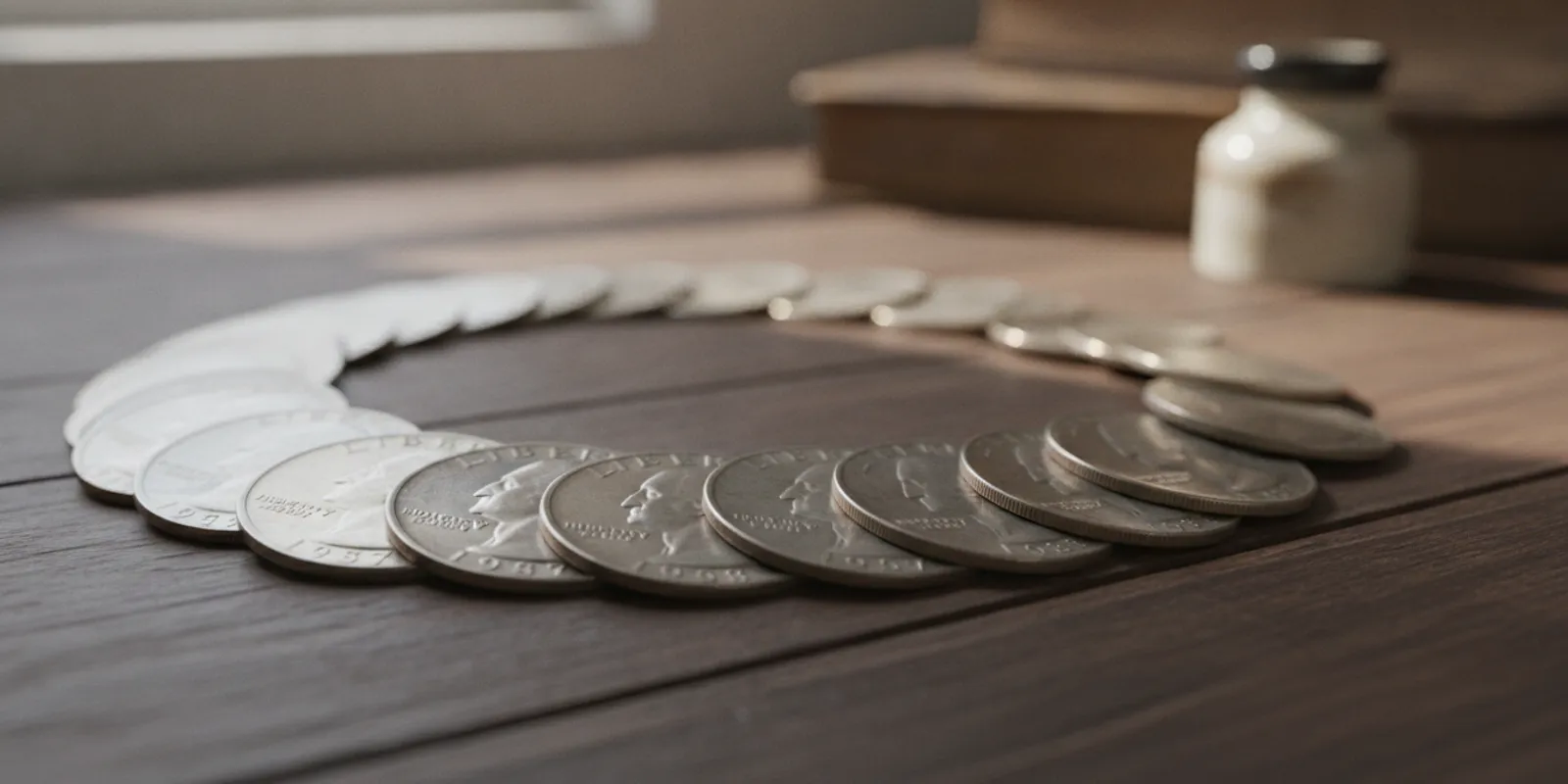
When you look up silver quarter value, the first question is whether the coin’s silver content is the main source of worth or whether collectors may value its date, mint mark, condition, or variety more. Those are related but different ways to assess a coin. Identifying the quarter carefully can help you understand what to ask before you sell or request an appraisal.
Ask about an appraisal for your silver quarters
What does silver content value mean?
Silver content value is an estimate based on the amount of silver in a coin and the current market price of silver. Many U.S. quarters dated 1964 and earlier were struck in 90% silver and 10% copper. A standard, unworn example contains about 0.1808 troy ounce of silver. Circulation wears away a small amount of metal, so an individual coin may contain slightly less.
This calculation gives a metal-based reference point, not a guaranteed sale price. The market price of silver changes, and a buyer’s offer can also reflect processing, operating costs, and the terms of the transaction. A quarter that is common in its date and condition may be valued largely for its silver, while a scarcer or unusually well-preserved example may attract collector interest as well.
Do not assume that every quarter with a silver-colored appearance is silver. Most U.S. quarters made for circulation from 1965 onward have a copper core and a copper-nickel outer layer. There are also special silver proof issues from later years, made for collectors rather than everyday circulation. Check the date and the coin’s characteristics before treating it as a silver issue.
How does collector value differ from silver value?
Collector value reflects demand for a particular coin as a collectible. It can depend on how many examples were made, how many survive, the coin’s condition, the appeal of its design, and the availability of similar coins. Silver content still matters, but it does not explain every difference between two quarters.
For example, two circulated quarters may contain nearly the same amount of silver. If one is a common date and the other is a scarcer date or mint-mark combination in a desirable grade, collectors may treat them differently. The comparison is not a promise that the scarcer coin will bring a specific amount. Demand changes, and the exact coin must be examined.
The American Numismatic Association’s overview of factors that influence coin values notes that mintage is one factor in determining a coin’s value. Mintage is the number of coins produced, but it is not the same as the number available to collectors today. Survival, condition, and current demand also matter when assessing an individual coin.
| What is being considered? | What it tells you | What it does not establish |
|---|---|---|
| Silver content | An estimate based on the coin’s silver weight and the current silver market | A guaranteed offer or final selling price |
| Date and mint mark | Which issue the coin may be, and whether it merits closer research | Rarity or value by itself; the specific variety and condition still need review |
| Condition and grade | How much wear or damage is present and how the coin compares with grading standards | A precise market value without considering the date, variety, and demand |
| Certification | A third-party opinion about authenticity and grade when issued by a recognized grading service | That a coin will sell for a particular amount or that certification is worthwhile in every case |
How can two similar quarters have different value?
Think of the metal estimate as a baseline, not a complete appraisal. Imagine two circulated Washington quarters from the silver era. Their silver content may be broadly similar, but one could be a common date with ordinary wear, while the other has a less common date and mint mark or a documented variety. The second coin may invite more collector interest, but only if its identity and condition support that conclusion.
Now compare a circulated coin with a sharply detailed example of the same date and mint mark. Better preservation can make a difference to collectors, yet a bright appearance alone does not prove a high grade. Marks, hairlines, cleaning, and damage can change how the surface is viewed. A coin that looks impressive to a new collector may still need expert assessment to distinguish original luster from later alteration.
A third comparison is a regular circulation strike versus a proof or another special issue. The proof may have been made for collectors, but the label is only one part of identification. Composition and issue details matter, and not every proof is scarce or in strong demand. Verify what the coin actually is before applying a price or description found online.
These examples explain why a single online number can be misleading. A price guide may describe a particular grade, a recent market, or an issue that is not the one in your hand. Check that every comparison matches the denomination, year, mint mark, variety, and grade as closely as possible. If you cannot confirm those details, treat the comparison as a prompt for research rather than a valuation.
Which dates should you check first?
Start by reading the date on the front of the quarter. For the familiar Washington quarter, the design began in 1932. Most U.S. quarters dated 1964 and earlier are 90% silver, but the date alone does not tell the whole story about collector interest. Some dates and mint-mark combinations are more sought after than common issues, and there are also special issues and varieties that need more precise identification.
Earlier U.S. quarter designs have different date ranges and design details. Barber quarters were made from 1892 to 1916, for instance. A quarter’s design period can help narrow down what you are looking at, but it does not substitute for checking the exact year, mint mark, and condition. A coin with a worn or partially obscured date may need careful examination under good light.
When researching a date, compare reliable references that identify the same design and mint-mark combination. Do not rely on a single broad price chart. An asking price in a listing is not proof of what a coin sold for, and a price for a high-grade certified coin may not apply to a worn coin of the same date.
It also helps to separate mintage from availability. Mintage records how many coins were struck, not how many remain today in a particular grade. Some coins were saved by collectors when issued, while others spent years in circulation. Survival and preservation can therefore shape the supply collectors can actually find. The same date may be relatively easy to locate in worn condition but harder to find with crisp details.
For a useful comparison, write down the full identification rather than searching only “silver quarter.” Include the design, year, mint mark, and any special designation shown on a certification label. If you are looking at a variety, record the exact variety name or diagnostic feature from a trusted reference. This makes it less likely that you will compare your coin with a different issue.
Online results can also mix asking prices, completed sales, dealer inventory, and estimates. Those figures answer different questions. A listing price is what a seller hopes to receive; it is not evidence that a buyer paid that amount. Even a completed sale may not be comparable if the coin had a different grade, variety, or selling arrangement.
Where is the mint mark, and why does it matter?
A mint mark identifies the U.S. Mint facility that struck a coin. On many Washington quarters from the silver era, the mark is on the reverse, near the bottom and below the eagle. Its placement changed on later issues. Because locations vary by design and year, check a reference for the exact quarter rather than assuming the mark appears in the same place on every coin.
Common mint-mark letters include D for Denver and S for San Francisco; coins without a mint mark were generally struck at Philadelphia during many periods. Mint marks can distinguish issues with different production histories. That information may guide further research, but a letter alone does not make a coin rare or valuable. The date, mintage, survival, grade, and collector demand all belong in the assessment.
Inspect the area closely without scraping or polishing the coin. A mark can be faint because of wear, dirt, damage, or lighting. If you are unsure whether a small feature is a mint mark or damage, take a clear photo of both sides and ask a knowledgeable coin professional to review it.
How does condition affect a silver quarter?
Condition is one of the most visible differences between circulated and uncirculated coins. A circulated quarter may show smoothing on the highest parts of the design, softened lettering, and small marks from use. An uncirculated coin may retain more original detail, though it can still have contact marks, spots, or other imperfections. Grade describes condition using a defined scale; it is not simply a judgment that a coin looks attractive.
Look at the hair, cheek, lettering, eagle, and feather details, depending on the design. Wear often appears first on raised areas. Also note scratches, edge damage, corrosion, discoloration, and evidence of cleaning. These observations are useful, but assigning a precise grade from a quick glance can be difficult. Lighting, magnification, and experience affect what can be seen.
Avoid cleaning a quarter to make it look brighter. Abrasive rubbing, dips, or household products can alter the surface and may reduce collector appeal. Keep the coin in a safe holder and handle it by the edges. If you are gathering several pieces for review, keep them separated so they do not rub together.
Which varieties should you look for?
A variety is a meaningful difference in a coin’s design or production, such as a doubled die, an overdate, or another documented die characteristic. A mint mark that appears unusual is not automatically a valuable variety. Marks, scratches, and other changes can result from damage after the coin left the Mint, so identification needs to be based on the specific issue and recognized diagnostics.
Use a dependable variety reference with clear photographs and compare the same date and mint mark. Check the position and shape of letters and numbers, as well as any specific doubling or design detail described by the reference. A casual resemblance is not enough. If the feature is unclear or the coin may be scarce, avoid making changes to it and get an informed opinion before deciding how to sell.
Proof quarters can also differ from regular circulation strikes. They were specially made for collectors and often have sharper details or reflective fields, but proof status alone does not determine value. The exact year, composition, preservation, and collector interest remain important.
Does certification change the assessment?
Third-party grading services can authenticate and grade coins, then encapsulate them in a protective holder. A certification label can make it easier to identify a coin and communicate its assigned grade. It does not guarantee a particular sale price. Buyers still consider the coin, its market, and demand for that specific date and grade.
Certification may be useful when a coin is valuable enough that an independent authentication and grade could help buyers evaluate it. It may be less useful for a common, heavily circulated quarter whose appeal is mainly its silver content. Fees, shipping, and time are part of the decision. Consider asking a professional whether certification is appropriate before submitting a coin, rather than assuming every old silver quarter should be graded.
If a quarter is already certified, note the grading service and the certification number. You can use those details to confirm the coin’s holder information and compare it with examples of the same issue. Keep the coin in its holder unless a qualified professional advises otherwise.
How can you prepare a quarter for an appraisal?
A little organization can make an appraisal discussion more useful. Gather the coins together, but keep them in individual holders or envelopes if possible. Do not polish them or attempt repairs. Then record what you can identify without handling them more than necessary.
- Sort by design and date. Separate Washington quarters from earlier designs, and group coins by year when the date is legible.
- Record mint marks. Note the mark and its location, or write “unclear” if you cannot identify it confidently.
- Make a simple condition note. Describe visible wear, damage, or a certification holder without assigning a grade you cannot verify.
- Photograph both sides. Use even light, keep the camera steady, and include close views of the date and mint mark. Avoid filters that change the coin’s appearance.
- Keep related information. If you have purchase records, family notes, or paperwork from a prior grading service, bring them along. Such records can provide context, but they do not replace examining the coin.
For an appraisal, be prepared to discuss whether you are considering selling the coins or simply want to understand what you have. A professional can review the issue, condition, and potential collector interest alongside its silver content. If you have a mixed group of coins or other silver items, identify which pieces you want reviewed so the conversation is clear.
Park Avenue Numismatics buys rare coins and precious metals from the public in Miami. You can learn more about its silver buying service in Miami or use the contact page to ask about your coins. The firm also has information on U.S. coin listings such as this certified 1947 half dollar, which illustrates how date, denomination, grade, and certification may be presented together. A half dollar is not a quarter, but the listing details show the kinds of identifying information collectors use.
How should you compare selling options?
Before choosing an approach, be clear about whether your priority is selling a single coin, selling a group, or getting more information first. A local dealer can examine coins in person, while an online transaction may rely more heavily on photographs, descriptions, shipping, and the seller’s process. Neither route removes the need to identify the coin accurately and understand the terms offered.
Compare offers on the same basis. Ask whether the assessment covers silver content alone or considers collector demand, whether the offer is for the entire group or individual coins, and whether any fees or other conditions apply. For an unusual date, variety, or certified coin, make sure the person reviewing it knows which details you believe may matter. You can also seek another opinion when the basis for an offer is unclear.
Do not treat a published estimate, online asking price, or silver spot quote as a guaranteed payout. The relevant amount depends on the exact coin and the conditions at the time of sale. If you decide to proceed, confirm the final terms directly with the buyer before transferring ownership.
Contact Park Avenue Numismatics about an appraisal
Frequently asked questions about silver quarter value
Are all quarters dated before 1965 silver?
Most regular U.S. quarters dated 1964 and earlier were made of 90% silver and 10% copper. Check the exact coin, since special issues and unusual pieces can require a closer look. Most circulation quarters from 1965 onward are copper-nickel clad rather than silver.
Does a mint mark automatically make a quarter rare?
No. A mint mark identifies where a coin was struck, but it does not establish rarity by itself. The specific date and mint-mark combination, how many examples survive, condition, and current demand all contribute to collector interest.
Should I clean a silver quarter before selling it?
No. Cleaning can scratch or otherwise change the coin’s surface and may harm collector appeal. Keep it protected, handle it by the edges, and let a professional examine it in its current state.
Is silver content value the same as the amount a buyer will pay?
No. A metal-content calculation is only a reference based on silver weight and the current silver market. An actual offer can vary with the coin’s condition, collector demand, transaction terms, and the buyer’s assessment.
Key takeaway
Silver content gives you one useful starting point, but it does not tell the whole story of a U.S. silver quarter. Confirm the date and mint mark, note condition and possible varieties, and consider whether certification is relevant before comparing selling options or requesting an appraisal.





