
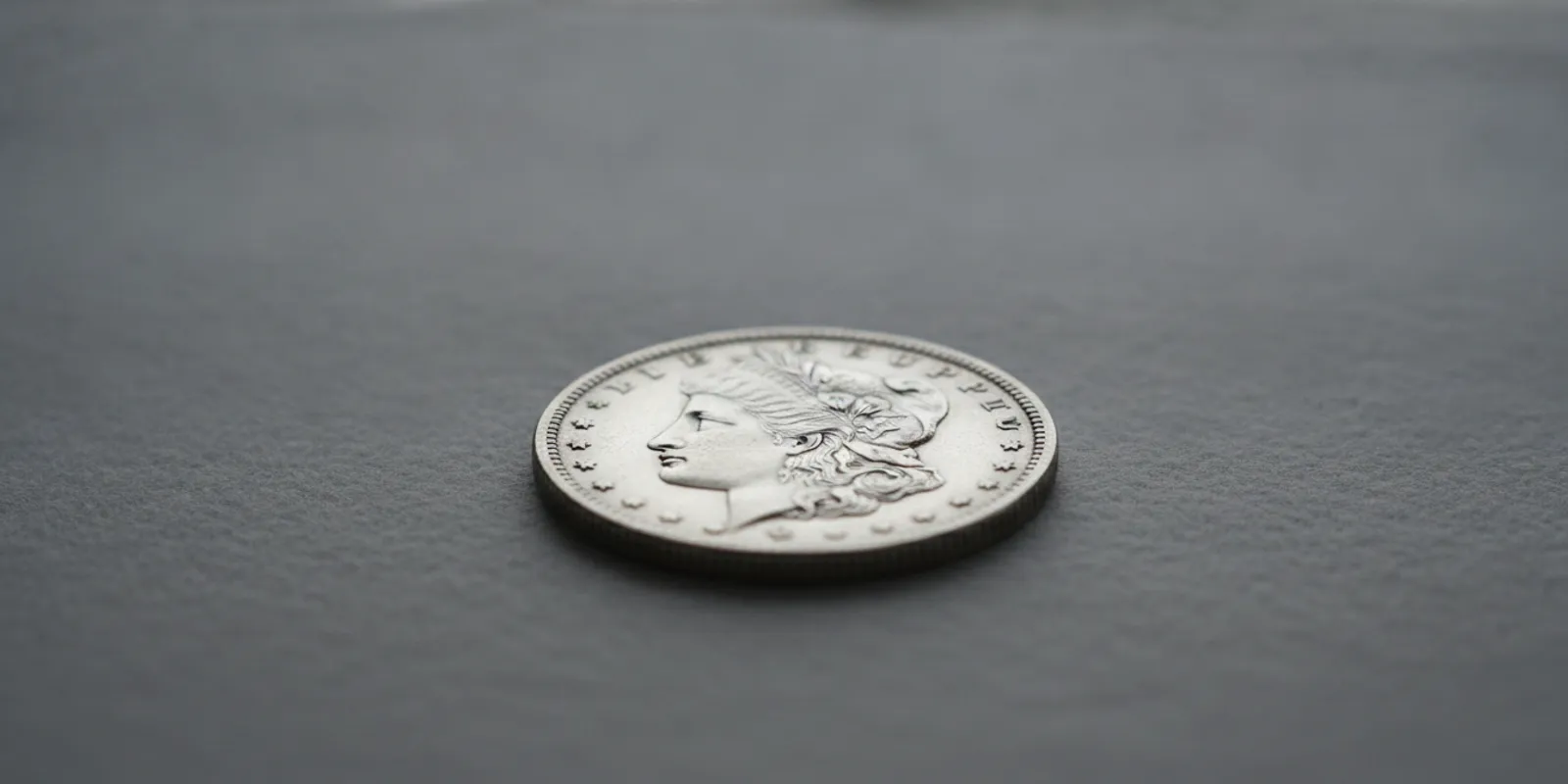
Morgan dollar grading describes a coin's condition using a standardized scale, but a grade is not a simple count of marks. Wear, remaining luster, surface preservation, strike, and overall appearance all shape an assessment. If you are examining a Morgan dollar, identify its date and mint mark, then look closely without cleaning or altering it.
Call 1-888-419-7136 to discuss a coin
What does Morgan dollar grading tell you?
Grading communicates a coin's relative state of preservation. The American Numismatic Association's grading guide describes a scale that ranges from Poor through Mint State 67. In broad terms, a circulated coin shows wear from use, while an uncirculated coin retains its original mint-state surfaces, though its grade still depends on preservation and appearance. The American Numismatic Association's Morgan dollar grading resource offers coin-specific examples.
A grade is useful shorthand, not a complete history or a guaranteed price. Two Morgan dollars with the same date and nominal grade can differ in eye appeal, strike, toning, and surface marks. A grade also does not by itself establish authenticity or provenance. Think of it as one part of a fuller description, not a substitute for identifying the coin and examining it carefully.
Grades on the circulated portion of the scale describe differing amounts of wear, while Mint State numbers describe degrees of preservation among coins without circulation wear. The number does not mean that every feature is equally strong. A higher-numbered coin generally has fewer or less distracting imperfections under the grading standard, but strike and visual character remain part of the assessment. A label is a compact conclusion reached after considering the coin, not a checklist that can be reduced to one visible mark.
Which features matter when examining a Morgan dollar?
Start with the whole coin, then inspect specific areas under good, even light. Avoid repeatedly handling the faces; hold the coin by its edge if safe. A magnifier can reveal small features, but strong magnification may make ordinary contact marks seem more important than they are. Look at the coin first at normal viewing distance, then use closer inspection to understand details.
- Wear: Look for flattening on the highest design points. On Morgan dollars, check Liberty's hair above the ear and over the forehead, as well as the eagle's breast feathers. A smooth area can indicate circulation, but strike weakness may also affect detail.
- Luster: Uncirculated coins may show cartwheel-like movement of light across the surface when tilted gently. Luster can be disrupted by wear, cleaning, or other surface changes.
- Marks: Contact marks, scratches, and scuffs vary in number, size, location, and visibility. Marks in open fields may draw the eye more than similar marks in protected design areas.
- Strike: Some details may be less sharply impressed even when the coin has not circulated. Weakness in striking should not automatically be mistaken for wear.
- Eye appeal: Color, toning, balance, and mark placement influence the overall appearance. These qualities require judgment, not a mechanical tally.
How do circulated and mint-state grades differ?
Circulated grades generally describe degrees of wear. A coin that has seen substantial use may have flattened high points and reduced design detail. As wear becomes less pronounced, more detail remains. At the uncirculated level, grading focuses on the coin's original surface, marks, strike, and visual quality rather than circulation wear.
That distinction is not always obvious to a new collector. A lightly circulated coin can still have attractive detail, while a coin that appears bright may have been cleaned or otherwise altered. Brightness alone does not prove that a coin is uncirculated. Compare high points and protected areas, and observe whether luster flows consistently across the fields and devices.
| What you observe | What it may suggest | What to check next |
|---|---|---|
| Flattening on the highest design points | Possible circulation wear | Compare those points with protected details and overall luster |
| Strong detail but subdued or interrupted luster | Surface change, handling, or another factor may be present | Inspect under even light; do not assume brightness or dullness alone sets a grade |
| Sharp design with scattered marks | Potentially uncirculated preservation with contact marks | Consider mark size, location, and visibility at normal viewing distance |
| Soft detail in one area without matching friction elsewhere | Strike weakness may be a possibility | Compare the design as a whole and seek experienced review |
Use the table as a prompt for further observation, not as a grading formula. For example, flattening at a high point becomes more informative when it appears with similar friction elsewhere and a break in luster. If a single area is soft but the surrounding surface retains its texture and light movement, strike may be worth considering. Neither observation alone settles the grade. The same visual clue can have a different significance depending on the coin's overall surface and design.
How should you inspect the coin in a consistent way?
A repeatable sequence helps keep one striking mark or attractive feature from dominating your impression. First, confirm which side you are viewing and note the coin's date and mint mark. Next, look at the entire obverse and reverse under neutral light. Then examine high points for friction, compare them with protected details, and gently tilt the coin to observe how light moves across the surface.
After assessing wear and luster, consider marks. Separate marks that interrupt the open fields from those located within the design, and notice whether a mark is shallow, deep, or especially visible. Do not try to convert these observations into a precise numerical grade. Grading standards involve judgment, and the effect of a feature depends on the coin as a whole.
Finally, step back and consider eye appeal. A technically strong coin may have an appearance that feels unbalanced because of distracting marks or uneven toning. Another coin with a lower grade may look pleasing and well-preserved for its level. Recording observations in plain language is more useful than prematurely settling on a number.
For a useful comparison, examine several coins of the same type when you have access to them, preferably under similar light and at the same viewing distance. Notice how friction, luster, and marks differ rather than relying on a single example as the standard. If a coin is certified, use its holder information as a reference point, but remember that a different coin with the same printed grade can have a distinct appearance. This exercise builds observation skills without implying that a home estimate is equivalent to a formal grade.
Why do date and mint mark still matter?
Condition is only one part of a Morgan dollar's significance. The date and mint mark identify the issue and may affect collector interest. The mint mark is on the reverse, above the letters in “DO” of DOLLAR, beneath the wreath. Depending on the issue, the space may be blank or show a mint mark. Record what you see rather than guessing if it is difficult to read.
Grading does not replace identification. Consider the date, mint mark, possible varieties, authenticity, and any certification alongside condition. Park Avenue's catalog includes Morgan dollar examples such as this 1883 Morgan dollar listing and a 1904 Morgan dollar listing. Listings show how issue and certified grade are presented, but a different coin may have different characteristics.
What should you avoid when checking a coin?
Do not clean or polish a Morgan dollar to make it look brighter. Cleaning can leave hairlines or alter the surface, and an altered coin may be assessed differently from one with undisturbed surfaces. Do not scrape, rub, or apply chemicals. Keep the coin in a suitable holder when possible and avoid touching its faces.
Also avoid assigning a grade from a single photograph. Lighting, camera angle, focus, and image processing can hide marks or exaggerate them. A photo can help document a coin or begin a conversation, but it cannot always show luster, surface texture, or subtle wear as clearly as an in-person examination. If you photograph it, include both sides and use steady, even lighting rather than filters or dramatic reflections.
Storage and handling matter while you are preparing to learn more. Keep a loose coin in an appropriate inert holder rather than a pocket, envelope that may shed fibers, or a container where it can slide against other objects. Avoid placing it on a hard surface and moving it around to photograph it. If it is already in a certified holder, leave it there; the holder preserves identifying information and helps limit direct handling. These precautions do not change a grade, but they can help prevent new marks or surface contact before an examination.
How can you prepare for an assessment?
A little preparation makes a discussion more useful. Keep the coin as it is, and gather information that helps identify it. If it belongs to a collection, preserve original labels, holders, receipts, or family notes rather than separating them from the item.
- Write down the date and mint mark, if visible.
- Note whether the coin is in a third-party grading holder and record its certification information without removing it.
- Take clear, well-lit photographs of both sides if you are sharing images first.
- Describe any known history or documentation, distinguishing known facts from family recollections.
- Ask what features informed the assessment and whether the coin's surfaces or authenticity need closer review.
For a collection, make a simple inventory rather than trying to grade every coin in advance. Group coins by type or date, and keep potentially related papers together. Add a brief note for each piece about its visible condition or holder, without writing on holders or placing labels against the coin. This gives you a useful record and reduces unnecessary handling.
When taking photographs, keep the camera steady and use diffuse, even light so details remain visible. Photograph the obverse and reverse separately, and include a close view of the date and mint mark if they are hard to read. Avoid filters that change the coin's color, and state plainly if a holder or reflection affects what the image shows. Good images can support an initial conversation, while the coin itself remains the best basis for examining surface texture and luster.
How can you compare two Morgan dollars responsibly?
Side-by-side comparison is most useful when you control the viewing conditions. Place the coins at the same distance under the same neutral light, and begin without a magnifier. Look at each coin's overall balance, then compare corresponding features: the hair detail, cheek, eagle's breast, wing feathers, and open fields. This prevents a dramatic mark on one coin from distracting you from other differences.
Next, rotate each coin gently through the light rather than moving the lamp repeatedly. Watch whether the surface reflects light evenly or whether a patch seems dull, shiny, or interrupted. Then check the same high points on both examples for friction. If one coin has softer design detail but uninterrupted luster, do not automatically call it more worn; compare other high points and protected areas before drawing a conclusion.
Make notes that describe what you see instead of assigning numbers too early. For instance, write “small marks in the left obverse field; strong detail; luster not fully visible through holder” rather than “probably MS-65.” Plain descriptions preserve useful observations and make it easier for another person to understand your reasoning. If the coins are in holders, record the labels, but do not assume that two coins with the same label will look identical.
How should you think about grade and value?
Grade can influence collector interest, but it does not determine value on its own. A coin's date, mint mark, rarity, condition, provenance, certification, and current market demand can all matter. Price estimates may vary, and an online guide or a single comparison is not a guaranteed offer for a particular coin.
When comparing information, make sure examples actually match the coin's issue and relevant condition. A retail asking price, an auction result, and a purchase offer are different kinds of figures. Check the date, mint mark, grade, and sale context before treating a comparison as useful. If those details do not align, the comparison may tell you little about your coin. Even two certified coins at the same grade can differ in appearance and market response.
What happens during an in-person review?
An in-person assessment can reveal details that are hard to judge from a photograph, including surface quality, luster, and signs of wear or alteration. At Park Avenue Numismatics, sellers can provide photos of their items, visit the Miami store for an assessment, and decide whether to proceed with a purchase. The assessment is specific to the coin or collection presented; it is not a promise that every Morgan dollar has the same value or outcome.
Park Avenue Numismatics has served collectors and sellers since 1988 and purchases rare coins and precious metals from the public. To learn more about the business and its background, see the Coin World feature. If you are considering selling, you can also arrange a visit to discuss your items in person.
Frequently asked questions about Morgan dollar grading
Can I grade a Morgan dollar at home?
You can make a preliminary observation by checking the date, mint mark, wear, luster, marks, and overall appearance. A home review is not a substitute for professional examination, especially when authenticity, subtle surface changes, or a significant issue is in question.
Does a bright Morgan dollar have a high grade?
Not necessarily. Brightness may reflect lighting, surface condition, or cleaning. Grading considers several features, including wear, luster, marks, strike, and eye appeal.
Should I remove a coin from its holder to inspect it?
Do not remove a coin from a certified holder just to examine it. Removing it can expose the coin to damage and may separate it from identifying information. Inspect it through the holder and seek guidance if you have concerns.
Does a grade guarantee what a Morgan dollar will sell for?
No. Grade is one factor among several, and market demand and the coin's other attributes can affect an assessment. Any value should be treated as variable rather than guaranteed.
Arrange an in-person coin assessment
Key takeaway
Morgan dollar grading brings together condition details best considered as a whole: wear, luster, marks, strike, and eye appeal. Identify the coin carefully, leave its surfaces untouched, and use a qualified in-person review when you need a clearer understanding of a specific Morgan dollar.





