
Two coins can share the same date, denomination, and metal yet appeal to very different buyers. The difference often begins at the Mint: one was made for everyday commerce, while the other received special preparation for collectors. That distinction affects surface appearance, grading terminology, and the premium you may pay.
Call 1-888-419-7136 to speak with a Park Avenue Account Specialist about building your coin collection with confidence.
Mint State vs Proof coins are distinguished primarily by how they are manufactured and graded. Mint State coins are business strikes that have not circulated, while Proof coins are specially struck on polished planchets and commonly show frosted design elements against mirrored fields. Your choice should reflect whether you value condition, visual contrast, collecting appeal, or broader market availability.
Before comparing prices or deciding which format fits your goals, it helps to identify exactly what a Mint State designation says about a coin. The grade, strike quality, and recognized details can tell you far more than the word uncirculated
alone.
What Are Mint State Coins?
Mint State coins are business-strike coins that never entered circulation, graded on the Sheldon scale from MS-60 to MS-70 based on preservation, luster, and surface quality.
When you examine a coin described as Mint State. You are looking at a business strike that was made for commerce or produced in the same manner as a coin intended for commerce. It may never have entered circulation, but it was not manufactured through the specialized Proof process. That distinction is central when you compare Mint State vs Proof coins.
The U.S. Mint glossary uses uncirculated for a coin that has not circulated, and the terms Mint State and uncirculated are often used interchangeably. The MS prefix tells you that the coin is being described within the uncirculated portion of the grading scale. It does not mean every MS coin has identical eye appeal or preservation.
How Mint State Coins Are Graded
Professional grading services grade Mint State coins from MS-60 through MS-70 on the Sheldon Scale. MS-60 identifies an uncirculated coin with notable marks or other imperfections, while higher grades indicate stronger preservation. MS-70 represents the top of the scale and requires an exceptionally flawless example under the applicable grading standards.
Grade is only one part of the description. The quality of the strike, the amount of contact marks, luster, surface preservation, and overall eye appeal all influence how a coin is evaluated. A coin can retain its original mint luster and still receive a lower Mint State grade because of marks or weakly defined details.
Special Designations You May See
Some Mint State coins receive additional designations that describe their appearance or strike. Key designations to recognize:
- Prooflike (PL): Indicates reflective fields that resemble a Proof coin, commonly seen on Morgan Dollars.
- Deep Mirror Prooflike (DMPL): Identifies an even deeper degree of field reflectivity than standard PL.
- Full Steps (FS): PCGS designation for Jefferson Nickels with complete step details on Monticello.
- Full Bands (FB): Designation for Mercury and Roosevelt Dimes with fully defined horizontal bands.
- Full Head (FH): Awarded to Standing Liberty Quarters with a complete head detail.
- Full Bell Lines (FBL): Designation for Franklin Half Dollars with distinct bell lines visible.
These labels can help you understand why two coins with the same numerical grade may differ in desirability. For a reliable assessment, look beyond the MS number and review the certification, photographs, designations, and surfaces together. That approach gives you a clearer basis for comparing an uncirculated business strike with a specially manufactured Proof.
What Are Proof Coins?
Proof coins are specially manufactured for collectors using polished planchets, specially prepared dies, and multiple strikes to create a distinct frosted-on-mirror appearance.
When you examine a Proof coin under good lighting, the design can appear to float above a dark, reflective surface. That appearance is intentional. A Proof coin is specially manufactured for collectors, rather than produced for everyday commerce. The U.S. Mint describes Proof as a specialized minting process in which a coin is struck multiple times so its softly frosted images stand out against a mirror-like field. You can review the Mint's explanation in its Proof Sets guide.
How the Proof Finish Is Created
Proof production begins with specially prepared dies and planchets. The planchet is polished before striking, and the dies receive preparation designed to create sharp detail and contrast. The coin is then struck more than once, often with greater pressure than a normal business strike. Those additional blows help bring out the design's fine details and produce a crisp, highly finished appearance. The Numismatic Guaranty Company explains that Proof coins are carefully struck multiple times on polished planchets to bring out the beauty of the design.
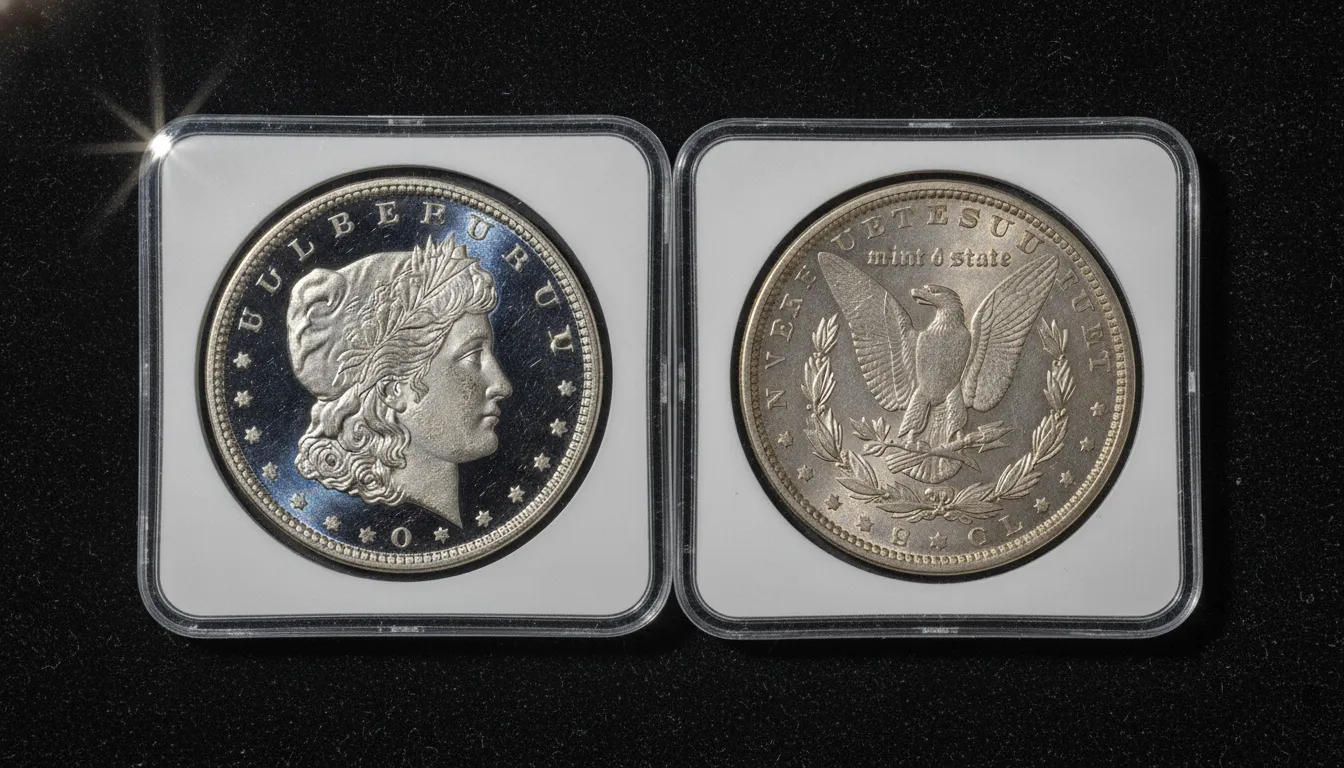
Frosted Devices and Mirrored Fields
The raised parts of the design, called the devices, usually have a softly frosted appearance. The open areas around them, called the fields, are polished to a mirror-like finish. The contrast between those two surfaces is known as the cameo effect. On a strong Proof, the portrait, lettering, and other raised elements look satiny or frosted, while the surrounding field reflects light like glass.
That contrast is one of the quickest visual clues when you compare Mint State vs Proof coins. A Mint State coin may have attractive luster from its original business-strike finish, but it was not made through the same collector-focused process. A Proof coin's mirrored fields can also show fingerprints, hairlines, or haze easily, so careful handling matters. Hold the coin by its edge and avoid touching either surface.
Proof Does Not Mean Circulated
Proof refers to how the coin was made, not simply to its condition after release. Proof coins are generally intended for collectors and are not intended for general circulation. They can still be damaged after leaving the Mint, which may affect their grade and desirability. For that reason, the Proof designation and the coin's preservation should be considered separately when you evaluate a purchase.
How Mint State and Proof Coins Compare: Key Differences at a Glance.
The most important difference between Mint State and Proof coins comes down to manufacturing process: business strikes for commerce versus specially prepared collector issues with cameo contrast.
When you compare Mint State and Proof coins, focus first on how each coin was made. Then consider how grading services describe its condition. The table below gives you a practical way to separate the two without confusing a highly preserved business strike with a true Proof issue. For a broader overview of coin categories, explore our guide to numismatic versus bullion coins.
| Dimension | Mint State | Proof |
|---|---|---|
| Manufacturing Process | Struck as a business strike for commerce, or in the same manner as a circulation coin. NGC explains the distinction. | Specially manufactured for collectors, typically with polished dies and planchets, and often struck more than once. |
| Appearance/Finish | Usually shows the original mint luster associated with an uncirculated business strike. Some Morgan dollars may earn PL or DMPL reflectivity designations. | Usually shows mirrored fields and frosted raised design elements, creating a sharp visual contrast. |
| Grading Scale | Receives the MS prefix, commonly from MS-60 through MS-70. MS and Uncirculated are often used interchangeably. | Uses the Proof or PR prefix on the same general Sheldon 1-to-70 framework, but the prefix identifies the coin's production method. |
| Intended Use | Made for commerce, even when the individual coin never enters circulation. | Made for collectors and not intended for general circulation. |
| Typical Premium | Premiums vary with grade, rarity, eye appeal, date, mintmark, and recognized designations. Do not assume every high-grade MS coin carries the same value. | Often commands a higher premium than a similar uncirculated non-Proof coin because of specialized production and aesthetic appeal. This is not a guarantee of future value. |
| Cameo Effect | Not the defining feature, although reflective fields can appear on designated Mint State coins. | The contrast between frosted devices and mirrored fields is called the cameo effect. |
| Strike Quality | May receive PCGS strike designations such as Full Steps, Full Bands, Full Head, or Full Bell Lines when key details are complete. | Multiple strikes and prepared surfaces are used to bring out fine design detail. |
| Collector Appeal | Appeals to collectors who value condition, mint luster, rarity, and specialized details in business strikes. | Appeals to collectors who value presentation, dramatic contrast, production quality, and the history of a special issue. |
For grading terminology and designations, review the standards used by PCGS and compare the certification details on the holder, not just the coin's surface appearance.
Understanding the Mint State vs Proof Coins Grading Scale
The grading scale uses the same 1-to-70 numerical framework for both types. But the prefix tells you whether the coin is a business strike (MS) or a specially manufactured collector issue (PR/PF).
When you compare Mint State vs Proof coins, the grading number is only part of the story. The prefix tells you how the coin was made and which grading scale applies. Both coin types use the Sheldon 1-to-70 numerical scale, but Mint State coins use the MS prefix, while Proof coins typically use PR or PF. To see how these grading distinctions apply across different coin categories, read our comparison of proof coins versus bullion coins.
How the Mint State Scale Works
Mint State coins are graded from MS-60 through MS-70. The MS designation identifies a business-strike coin that has never been in circulation. That does not mean every MS coin looks identical. An MS-60 coin may show noticeable marks, weak luster, or other limitations. Progressively higher grades reflect stronger eye appeal, fewer imperfections, and better preservation.
At the top of the scale, MS-70 represents a coin that is flawless under 5x magnification according to PCGS standards. Because the difference between a high-grade coin and a perfect coin can be extremely subtle, professional grading requires controlled examination, appropriate lighting, and trained judgment. PCGS also uses additional designations for certain Mint State coins, including Full Steps, Full Bands, Full Head, and Full Bell Lines, when important design details are fully visible. PCGS explains these strike designations in detail.
How Proof Grading Differs
Proof coins generally receive grades from PR-60 to PR-70 or PF-60 to PF-70. The numerical range matches the Mint State range, but the prefix signals a different production method. Proofs are usually struck more than once from specially prepared dies and planchets, creating sharp detail and the reflective fields collectors expect.
A Proof coin can still receive a lower grade if it has hairlines, contact marks, spots, or other impairments. A PR-70 or PF-70 coin must meet the highest standard for its category, just as an MS-70 coin must meet the highest Mint State standard. The number alone does not make a Proof equivalent to a Mint State coin, because each is judged within its own category.
As you evaluate a certified coin, read the full label rather than focusing only on the number. The prefix, strike quality, surface preservation, finish, and any recognized designation all help explain what you are buying. That context is essential whether you collect Mint State coins, Proof coins, or both.
Which Is Right for You? Collectors vs Investors
Your collecting goals and budget determine whether Mint State or Proof coins suit you better: collectors prize Proof presentation while investors often favor the broader market access of Mint State coins.
Choosing between Mint State and Proof coins becomes easier when you start with your purpose. Follow these three steps to narrow your focus:
- Define your primary goal. Are you collecting for visual quality and rarity, or investing for broad market recognition and easier resale?
- Compare premiums. Proof coins carry higher premiums due to specialized production and cameo contrast. Mint State coins offer lower entry costs and wider availability.
- Evaluate certification. Review PCGS or NGC population reports for your target date and mintmark. Low-population coins in either finish may carry stronger long-term interest.
Your answer can point you toward one finish, although many collectors and investors choose to own both.
Why Collectors Often Prefer Proof Coins
Proof coins are generally made with collectors in mind, and their presentation is a major part of the appeal. Polished fields and frosted design elements can create a cameo effect, giving the portrait, lettering, or other devices a striking contrast against a mirrorlike background. Limited mintages and careful production can also make individual Proof issues especially attractive to collectors who value scarcity and visual distinction.
That appeal often comes with a higher premium than a similar Mint State coin. The premium may reflect the coin's finish, mintage, demand, condition, and certification, rather than its metal content alone. You can compare Mint State and proof coin sets to see how the two formats support different collecting goals. Silver American Eagles in both finishes also provide a familiar example of how the same coin design can appeal to different buyers.
Why Investors May Lean Toward Mint State Coins
Mint State coins are business strikes that were not circulated, and they often have broader market appeal. Because they typically carry lower premiums over the spot value of their metal than comparable Proof issues, they can offer a more accessible starting point. Their familiar grading range and wide availability may also make them easier for more buyers to understand when you later evaluate liquidity.
That does not make Mint State coins automatically better investments. Demand, certification, population reports, condition, rarity, and market timing all affect value. A high-grade Mint State coin can be highly collectible, while a common Proof may have limited resale demand. You should treat any coin purchase as a decision involving market risk, not as a guaranteed return.
Building a Balanced Approach
You do not have to choose only one category. Proof coins can add visual impact and collector interest, while Mint State coins may provide broader exposure and lower-premium options. If you are assessing inherited coins, assembling a collection, or comparing potential purchases, professional guidance can help you weigh condition, certification, rarity, and your objectives together. Park Avenue Numismatics has served collectors and investors in Miami for more than 38 years. Visit the team for rare coin collecting and appraisals, or contact us to speak with an expert about which combination fits your goals. Learn more about our history and numismatic expertise on our about page.
Frequently Asked Questions
Are proof coins worth more than Mint State coins?
Often, a proof coin carries a higher premium than a comparable Mint State coin because it was specially produced for collectors and typically offers a distinctive finish. That premium is not automatic. Date, rarity, grade, preservation, demand, and certification all affect value, so compare like coins rather than relying on the label alone.
Which is better, Mint State or proof?
Neither is universally better. Choose Mint State when you value original business-strike luster, broader availability, or a grade-focused collection. Choose proof when you prefer mirrored fields, frosted design details, and a presentation-oriented collectible. Your budget, collecting goals, and tolerance for premiums should guide the decision.
What is the difference between proof and Mint State coins?
Mint State coins are business strikes made for commerce or in the same manner, while proof coins are specially manufactured for collectors. Proofs use polished planchets and specially prepared dies, often with multiple strikes, to create mirrored fields and frosted design elements. Mint State coins are graded MS, and proofs use a PR or PF prefix.
Are proof coins meant for circulation?
No. Proof coins are made as collector pieces rather than for general circulation. Handle them carefully and keep them in appropriate holders, since fingerprints, scratches, and improper cleaning can damage their surfaces and reduce their desirability.
Is Mint State the same as uncirculated?
In numismatic usage, Mint State and uncirculated are commonly used interchangeably for a coin that has not circulated. Mint State grades generally run from MS-60 through MS-70, with the grade reflecting the coin's condition and visible surface characteristics.
Ready to Compare Coins With Confidence?
Choosing between Mint State and Proof coins depends on your collecting goals, condition preferences, and understanding of the market. A knowledgeable review can help you evaluate those differences before adding to your collection. Whether you are a first-time buyer or an experienced collector, Park Avenue Account Specialists are ready to help you find the right coins for your goals. Call 1-888-419-7136 today to discuss your coin collection with an expert.