Have you ever pulled a coin from your pocket change and noticed something strange about it — something that did not look quite right? Maybe the date appeared doubled, the design was off-center, or part of the edge was missing. What you may have found is not a damaged coin. It is a mint error, and it could be worth considerably more than its face value.
Mint errors are coins that were incorrectly struck during the manufacturing process at the U.S. Mint. Because they are unintentional, they are rare by definition. Some error coins sell for hundreds or even thousands of dollars at auction. This guide covers seven of the most common and valuable mint error types, what causes them, how to identify them, and why collectors prize each one.
Think you have found an error coin? Call 1-888-419-7136 to speak with a Park Avenue Account Specialist. Browse our encyclopedia of U.S. coins for detailed information on coin series and varieties.
1. Off-Center Strikes
An off-center strike occurs when the coin blank, called a planchet, is not properly positioned between the coin dies when the strike happens. Instead of the design being centered on the round planchet, part of the design is shifted to one side, leaving a blank crescent-shaped area on the opposite side.
What to look for: The most valuable off-center strikes show a complete date and mint mark. If the date is fully visible and the blank area covers roughly 10 to 15 percent of the coin, the premium can be significant. As the off-center percentage increases beyond 50 percent, the value often decreases because key design elements are missing.
Why collectors value them: Off-center strikes are visually dramatic. Each one is unique in its shift pattern, and the most dramatic examples — those showing 30 to 50 percent off-center with a complete date — command strong premiums. A dramatic off-center Lincoln cent can sell for $50 to $200 in lower grades, while major errors on silver coins can reach into the thousands.
2. Doubled Die Errors
A doubled die error occurs when a coin die receives two offset impressions during its manufacturing process. When the die strikes the planchet, the doubled design transfers to every coin that die produces. This creates visible doubling in the lettering, date, or design elements.
What to look for: True doubling appears as a clear split in the design — two distinct images slightly misaligned. The doubling is usually most visible in the lettering and date. The most famous example is the 1955 Lincoln cent doubled die obverse, where the date and the word "LIBERTY" show dramatic doubling visible to the naked eye.
Why collectors value them: Doubled die errors are among the most sought-after mint errors in American numismatics. The 1955 doubled die Lincoln cent in circulated condition regularly sells for over $1,000, with uncirculated examples reaching $5,000 or more. Even modern doubled die varieties from the 1990s and 2000s can command premiums of $50 to $500 when the doubling is strong.
3. Wrong Planchet Errors
A wrong planchet error happens when a coin is struck on a blank intended for a different denomination. These are among the most dramatic and valuable errors because they combine the design of one coin with the size, weight, and metal composition of another.
What to look for: The most obvious sign is a size mismatch — a dime design on a planchet the size of a penny, for example. These coins will weigh the same as the planchet they were struck on, not the coin they appear to be. A Lincoln cent struck on a dime planchet would weigh roughly 2.3 grams instead of the standard 2.5 grams for a zinc cent.
Why collectors value them: Wrong planchet errors are rare and instantly recognizable. A Lincoln cent struck on a dime planchet can sell for $300 to $800, while more dramatic examples like a Sacagawea dollar struck on a quarter planchet have sold for over $5,000 at auction. These errors are highly prized in the error coin collecting community.
Interested in learning more about error coin values? Call 1-888-419-7136 and ask to speak with a Park Avenue Account Specialist.
4. Brockage Errors
A brockage error occurs when a previously struck coin sticks to one of the dies and then strikes the next planchet. The result is a coin with a normal design on one side and a mirror-image incuse impression on the other side. The incuse image is sunken into the coin instead of raised.
What to look for: Brockage coins show a reversed, sunken image on one side. If the stuck coin was from the obverse die, the brockage side will show a mirror-image sunken obverse design. The effect is visually striking — like pressing a coin into soft clay and seeing the impression it leaves.
Why collectors value them: Brockage errors are fascinating because they capture a direct artifact of the minting process. Full brockages — where the entire design is transferred — are rarer than partial ones. A full brockage on a common date coin can be worth $100 to $500, while dramatic examples on silver coins or in mint state can bring much more.
5. Die Cracks and Cuds
As a coin die is used to strike thousands of coins, the immense pressure causes the die metal to fatigue. Small cracks develop on the surface of the die, and these cracks transfer raised lines onto every coin the die strikes afterward. When a piece of the die actually breaks off, the resulting raised area on the coin is called a cud.
What to look for: Die cracks appear as thin raised lines running across the surface of the coin, often radiating from the rim inward. Cuds are larger raised, irregular areas of metal, usually found at the rim, where the die has actually chipped away. These are visible without magnification on most examples.
Why collectors value them: Die cracks and cuds are among the most affordable entry-point error coins. Many die crack varieties can be collected for under $20, making them accessible for new collectors. Larger cuds, especially on silver coins or key dates, can sell for $50 to $300. They are also valuable for die-variety research, helping numismatists track die usage and mint production patterns.
6. Clipped Planchets
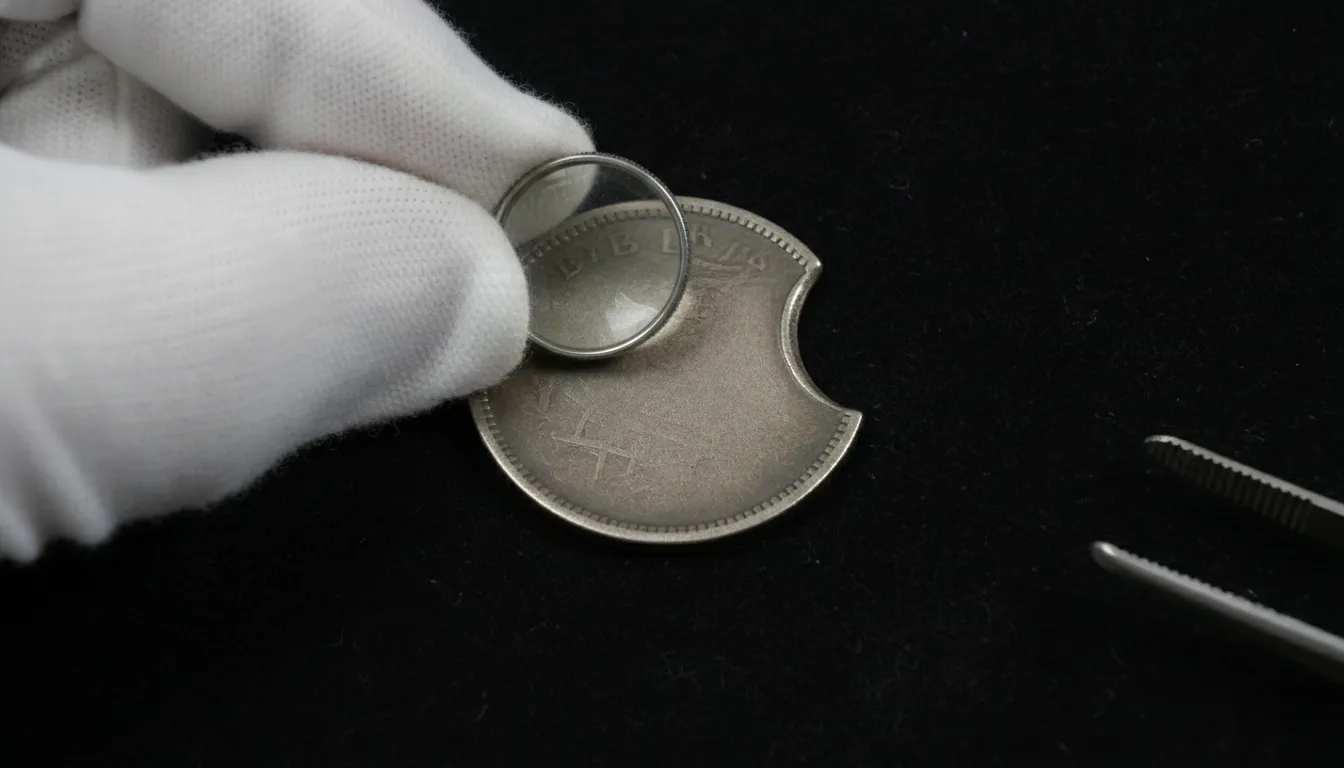
A clipped planchet occurs when the metal strip from which coin blanks are punched shifts during the punching process. The punch cuts through an area that was already partially punched, resulting in a blank that is missing a section of metal. When the coin is struck, it will have a smooth, curved missing section along its edge.
What to look for: The telltale sign is a smooth curved edge where part of the coin is missing. Unlike a coin that has been physically damaged or filed down, the missing area on a clipped planchet will have a smooth, flowing curve that matches the curvature of the coin. The edge will show the normal coin edge detail where it exists and a completely smooth surface where the clip is.
Why collectors value them: Clipped planchets are one of the more common error types, which makes them an excellent starting point for new error coin collectors. Minor clips (5 to 10 percent missing) on common coins can be found for $10 to $50. Major clips of 20 percent or more are significantly rarer and can command $100 to $400 on the right coin.
7. Mule Coins
A mule coin is created when two dies that were never intended to be paired together are used to strike a single coin. These are the rarest and most valuable category of mint errors because they represent a fundamental breakdown in the mint's quality control process.
What to look for: The most famous modern mule is the 2000 Sacagawea dollar obverse paired with a Washington quarter reverse, creating a coin with a dollar coin obverse and a quarter reverse. These mismatched designs are immediately obvious. Other mules involve different denominations or designs that do not belong together.
Why collectors value them: Mule coins are exceptionally rare. Only a handful of known specimens exist for most mule varieties. The 2000 Sacagawea/Quarter mule is one of the most famous U.S. error coins, with fewer than 20 known examples. Authenticated specimens have sold for $50,000 to $150,000 at auction. Any coin suspected to be a mule should be authenticated by a professional grading service immediately.
How to Start Your Error Coin Collection
Building an error coin collection does not require a large budget. Start with affordable error types like clipped planchets and die cracks, which can often be found for under $50. Study the specific varieties within each error type and learn what makes one example more valuable than another.
Practical tips for beginners:
- Start with modern coins: Lincoln cents from the 1970s through today are inexpensive and offer many error varieties to study.
- Use proper magnification: A 10x loupe is essential for identifying doubling, die cracks, and other fine details.
- Buy certified errors: Stick with PCGS or NGC certified error coins for your first purchases to ensure authenticity and accurate attribution.
- Work with reputable dealers: A trusted coin dealer with numismatic expertise can help you identify genuine errors and avoid common counterfeits.
Park Avenue Numismatics has been helping collectors build meaningful collections for 38 years. Our team holds A+ BBB rating and has facilitated over $1 billion in trusted transactions. Located on Biscayne Boulevard in Miami, we evaluate error coins and help collectors understand what their finds are worth. For those interested in alternative precious metals investments, see our comprehensive guide to buying gold.
Frequently Asked Questions About Mint Error Coins
What is the most common mint error coin?
Die cracks and minor clipped planchets are among the most common mint errors. They occur relatively frequently in the minting process and are a great starting point for new collectors.
Are mint error coins worth more than regular coins?
Yes, most mint error coins carry a premium over their regular counterparts. The premium depends on the type of error, its visibility, the coin's condition, and its rarity within that error category.
How can I tell if a coin has a mint error or is just damaged?
Mint errors occur during the striking process and have specific characteristics. Damage that happens after minting usually shows irregular wear, scratches, or unnatural edges. A reputable coin dealer or professional grading service can provide a definitive answer.
Should I clean a mint error coin I found?
Never clean a coin you suspect may be an error. Cleaning significantly reduces a coin's value and can make authentication difficult for grading services.
Where can I get a mint error coin authenticated and valued?
Professional grading services like PCGS and NGC authenticate and attribute error coins. Local coin dealers can also provide preliminary evaluations and guidance on whether professional grading is worthwhile for your specific coin.
Ready to have your error coins evaluated? Call 1-888-419-7136 to speak with a Park Avenue Account Specialist at our Miami location on Biscayne Boulevard. If you are looking to buy or sell gold coins, our team can assist with every step of the process.
Disclaimer: Past performance is no guarantee of future results. Coin values can fluctuate based on market conditions. Always consult with a professional numismatist before making buying or selling decisions.