
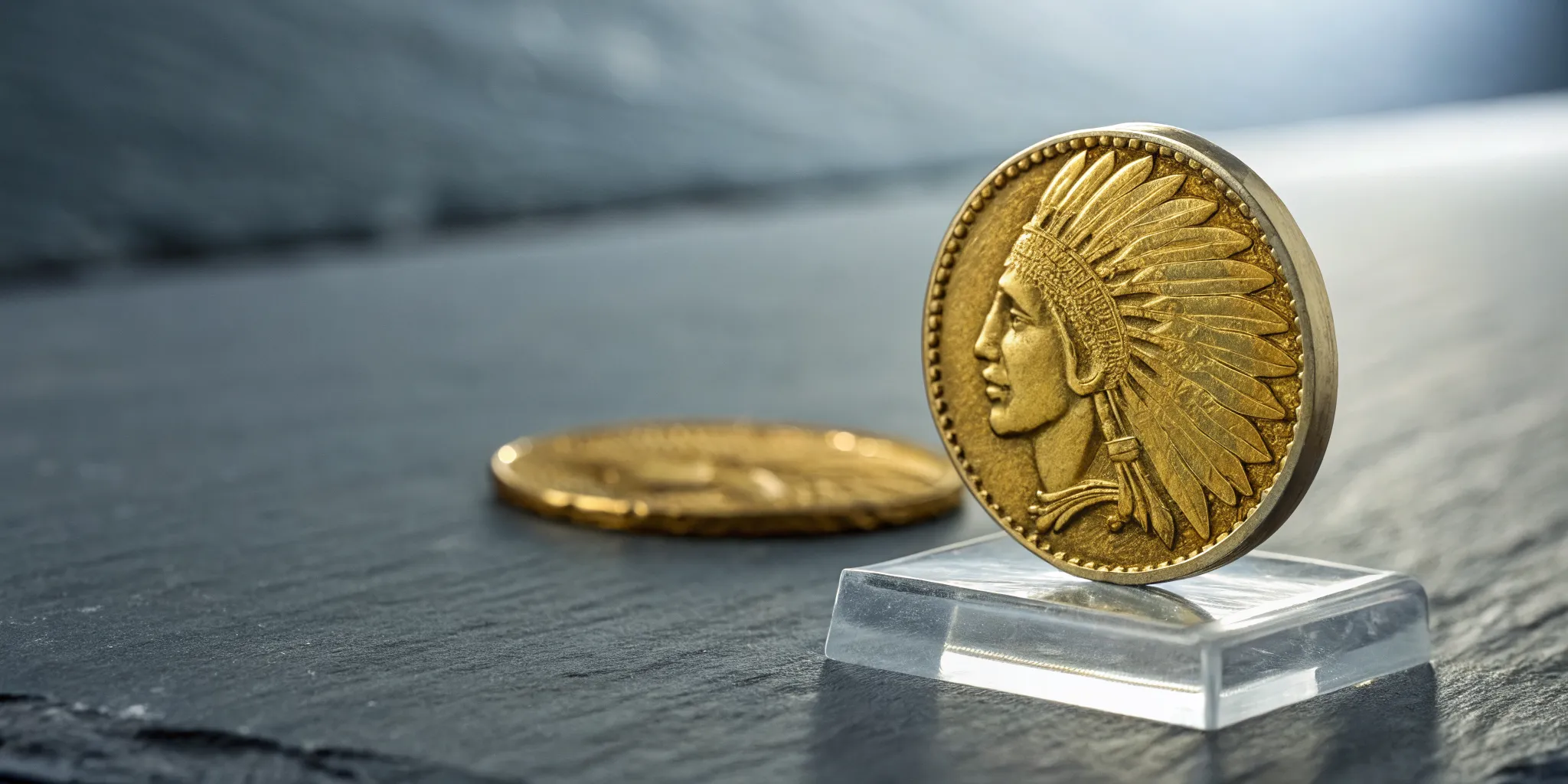
 Most coins are designed to be read by touch, with raised features that stand out from the surface. The Indian Head Gold Quarter Eagle does the exact opposite. Its design is pressed into the coin, creating a smooth, flat plane with sunken details that draw you in. This "incuse" style was a radical experiment, a piece of pocket-sized art that broke over a century of minting tradition. This artistic choice is what makes the coin so compelling. It’s not just a piece of gold; it’s a testament to a time when the U.S. government dared to turn everyday money into something beautiful, controversial, and unforgettable.
Key Takeaways
- Look beyond the gold for its true value: This coin's worth is a blend of its gold content and its rich history. Its unique incuse design and connection to President Roosevelt's vision for beautiful currency give it a numismatic premium that bullion coins lack.
- Check the date and grade to determine price: Not all Quarter Eagles are created equal; a coin's value hinges on its condition and rarity. A common date in circulated condition is accessible, while a key date like the 1911-D in high grade is a significant investment.
- Prioritize certified coins from a trusted dealer: The best way to protect your investment is to buy coins professionally graded by PCGS or NGC. This guarantees authenticity and provides a clear, market-accepted assessment of the coin's condition and value.
The Story Behind the Indian Head Gold Quarter Eagle
Every great coin has a story, and the Indian Head Gold Quarter Eagle’s tale is one of presidential ambition, artistic innovation, and public controversy. This coin didn’t just appear; it was born from a desire to transform American currency into pocket-sized works of art. Understanding its history is key to appreciating its value as both a collector's piece and a tangible piece of the American story. From its unconventional design to its abrupt end, the quarter eagle captures a fascinating moment in time.
Theodore Roosevelt's Vision for American Coinage
The Indian Head Quarter Eagle owes its existence to President Theodore Roosevelt’s personal mission to create more artistic American coins. He felt the nation's currency was uninspired and wanted to produce coins that rivaled the beauty of ancient Greek and Roman money. Inspired by the high-relief art and incuse designs of classical coinage he had seen in museums, Roosevelt commissioned a "pet crime," as he called it: a complete redesign of America's pocket change. This ambitious project led to some of the most celebrated rare US coins ever minted, including the iconic Saint-Gaudens Double Eagle and this unique quarter eagle, which broke from tradition in a dramatic way.
Bela Lyon Pratt: The Sculptor Behind the Design
To bring his vision to life, Roosevelt turned to the nation’s top artists. For the quarter eagle, the commission went to Boston sculptor Bela Lyon Pratt, a former student of the renowned Augustus Saint-Gaudens. Pratt was tasked with creating a design that was both beautiful and practical, a challenge given the technical limitations of minting. He chose a realistic portrait of a Native American chief for the obverse and a standing bald eagle for the reverse. His boldest choice, however, was to sink the entire design into the coin’s surface, a technique that would make the Indian Head Quarter Eagle unlike any other coin produced by the U.S. Mint.
Why the Incuse Design Was So Controversial
Pratt’s incuse design, where the features are sunken below the coin's flat surface, was a radical departure from tradition. This method protected the design’s details from wear and allowed the coins to stack neatly, solving common problems with high-relief coins. Despite these practical advantages, the public reaction was overwhelmingly negative. Many people found the design unattractive, while others voiced concerns that the recessed areas would collect dirt and spread disease. This controversy, though based on unfounded fears, makes the coin’s story all the more compelling for collectors today who appreciate its unique place in the history of gold bullion.
Minting Years and the Great Depression's Impact
The Indian Head Gold Quarter Eagle was minted from 1908 to 1915, took a brief hiatus, and then resumed production from 1925 until 1929. The series came to an abrupt halt with the stock market crash of 1929 and the onset of the Great Depression. As the economic crisis deepened, the U.S. government moved away from gold currency, culminating in President Franklin D. Roosevelt’s 1933 executive order that recalled most gold coins from circulation. This decision effectively ended the era of circulating gold coinage in America, freezing the Indian Head series in time and securing its status as a finite and historically significant artifact.
Anatomy of an Indian Head Quarter Eagle
To truly appreciate the Indian Head Quarter Eagle, you need to know its unique features. Unlike any U.S. coin that came before it, its design and composition tell a story of artistic innovation and a new vision for American currency. Getting familiar with its anatomy is the first step for any serious collector, as these details are key to understanding its grade, authenticity, and value. From the striking portrait on the front to its distinctive sunken design, every element makes this coin a fascinating piece of numismatic history.
Obverse: The Native American Chief
The front, or obverse, of the coin immediately sets it apart. It features a realistic and powerful portrait of a Native American chief wearing a full war bonnet. This was a significant departure from the traditional female figures of Liberty that had graced American coins for over a century. The design, created by sculptor Bela Lyon Pratt, was intended to be uniquely American. The chief’s portrait is framed by 13 stars, representing the original colonies, with the word “LIBERTY” inscribed at the top. This bold and detailed image is one of the main reasons these rare coins for sale remain so popular with collectors today.
Reverse: The Bald Eagle
On the reverse, you’ll find a proud bald eagle, a powerful symbol of the United States. The eagle is shown perched on a bundle of arrows and an olive branch. This classic pairing represents the nation’s readiness for war (the arrows) and its desire for peace (the olive branch). Above the eagle are the mottos “E PLURIBUS UNUM” and “IN GOD WE TRUST,” with the denomination “2 1/2 DOLLARS” inscribed below. Unlike the obverse, the reverse design is more traditional, but its execution within the incuse format gives it a distinct character that complements the coin’s overall aesthetic.
Gold Content, Weight, and Purity
For investors and collectors alike, the coin's metallic content is a crucial detail. Each Indian Head Quarter Eagle contains 0.1209 troy ounces of fine gold. The coin itself is composed of 90% gold and 10% copper. This alloy, often called "crown gold," was standard for U.S. gold coins of the era. The addition of copper makes the coin harder and more durable, which helped it withstand the rigors of daily circulation. While its numismatic value often far exceeds its melt value, understanding its base gold bullion content provides a solid floor for its worth.
The Unique Incuse Design
Perhaps the most talked-about feature of the Indian Head Quarter Eagle is its incuse design. This means the artwork and lettering are stamped into the metal rather than raised above the surface, as with traditional coins. This technique gives the coin a smooth, flat field with sunken design elements. At the time, this was a revolutionary and controversial choice. Critics worried that the recessed areas would collect dirt and spread germs, though these fears were largely unfounded. Today, the incuse design is what makes the coin a standout piece in any collection and presents a unique challenge when assessing wear and condition.
Key Dates, Mintmarks, and Rarity
When you start looking at Indian Head Quarter Eagles, you’ll quickly learn that not all coins are created equal. Three key factors separate a common coin from a true collector’s prize: its date, its mintmark, and its original mintage number. Think of these details as the coin's birth certificate. They tell you when, where, and how many of its kind were made. Understanding these elements is the first step toward assessing a coin's rarity and historical significance. For collectors, this knowledge is crucial for building a valuable and meaningful collection.
Key Dates to Know
The Indian Head Gold Quarter Eagle had a relatively short but interesting production run. The U.S. Mint produced these coins from 1908 to 1929, but not continuously. Production stopped between 1916 and 1924, creating a significant gap in the series that collectors should note. The entire series came to a halt in 1929 with the onset of the Great Depression, as the government shifted its economic priorities. This specific timeline makes the series a finite and historically contained set. Knowing these start, stop, and end dates helps you place each coin in its proper context and understand the overall availability of the series.
Understanding Mintmarks: P, D, and S
A mintmark is a small letter on a coin that tells you which U.S. Mint facility produced it. While some coin series were struck at various mints, including San Francisco (S), the Indian Head Quarter Eagle series was only produced at two locations: Philadelphia and Denver. Coins from the Philadelphia Mint have no mintmark, which is the standard for that facility. Coins struck in Denver feature a small “D” on the reverse, to the left of the arrowhead. The presence, or absence, of that tiny "D" can significantly impact a coin's value, as it points to different mintage numbers and historical availability. You can explore our collection of rare coins for sale to see examples.
Spotting Low-Mintage Years
The ultimate prize for many collectors is finding a "key date" coin, which is a year with a very low mintage. For the Indian Head Quarter Eagle, the undisputed champion of rarity is the 1911-D. With a minuscule production of just 55,680 coins, the 1911-D is the hardest to find and most sought-after coin in the entire series. When you compare that to a common year like 1927, which saw over 388,000 coins minted, you can see why the 1911-D commands such a premium. Scarcity drives demand, and this low mintage figure makes the 1911-D a centerpiece for any serious collection of American gold coins.
What Is an Indian Head Gold Quarter Eagle Worth?
Determining the value of an Indian Head Gold Quarter Eagle is more complex than simply checking the daily price of gold. While its gold content provides a baseline value, the coin's worth is a dynamic mix of its physical condition, rarity, and the current demand from collectors. This is why you can see prices vary dramatically, from around $500 for a common, circulated coin to over $70,000 for a pristine, rare specimen.
Understanding these key factors is the first step for any serious collector or investor. A coin's grade, its mintmark, the year it was struck, and its overall eye appeal all play a crucial role in its final market price. Unlike simple gold bullion, where value is tied directly to weight and purity, the Indian Head Quarter Eagle has a rich numismatic story that adds layers of value. By breaking down these components, you can get a much clearer picture of what your coin is, or could be, worth.
How Grade and Condition Affect Price
A coin's grade, or its physical condition, is one of the most significant factors in its valuation. For Indian Head Quarter Eagles, the difference between a heavily worn coin and a perfectly preserved one can mean thousands of dollars. Common, circulated examples often trade for a modest premium over their gold value, typically in the $850 to $1,000 range. However, high-grade, uncirculated specimens can command prices well into the thousands. Because of the coin's unique incuse design, wear appears differently than on traditional coins, making professional grading essential for an accurate assessment. Even a small change in grade can have a major impact on the value of these rare coins for sale.
How Gold Spot Price Affects Value
Every Indian Head Quarter Eagle contains 0.12094 troy ounces of pure gold, which gives it a foundational, intrinsic value. This is often called its "melt value," and it's determined by the daily spot price of gold. This price acts as a safety net; no matter the coin's condition or rarity, its value will not fall below what its gold content is worth. Think of the spot price as the starting point. From there, numismatic factors like condition, rarity, and collector demand add a premium, which is why these coins almost always sell for more than their simple melt value.
Collector Demand vs. Bullion Value
The Indian Head Quarter Eagle series is incredibly popular with collectors, which creates a strong and consistent demand that pushes its value beyond its gold content. Many describe it as a "fun and satisfying collection" because, with the exception of one major key date (the 1911-D), the series is relatively easy to complete compared to other classic U.S. gold coin sets. This accessibility keeps demand high, as new and experienced collectors alike seek to build their sets. This numismatic interest means you are holding an asset valued for its history and rarity, not just as a piece of precious metal.
Researching Market Trends and Sales Data
To get a true sense of an Indian Head Gold Quarter Eagle's worth, you need to look at recent sales data. Prices are not static; they change with market trends and collector interest. Resources like the NGC Coin Explorer offer a comprehensive database of coin information, including population reports and auction data, which can help you understand a specific coin's rarity and historical value. Reviewing recent auction results and price guides from reputable dealers also provides a real-time snapshot of what collectors are willing to pay. This research helps you make informed decisions, whether you are buying, selling, or simply evaluating your collection.
How to Authenticate an Indian Head Gold Quarter Eagle
Knowing how to authenticate a coin is a crucial skill for any serious collector. The Indian Head Gold Quarter Eagle, with its beautiful and unusual design, is a frequent target for counterfeiters. Getting familiar with its specific characteristics is your best defense and ensures you’re adding a genuine piece of history to your collection.
Key Design Details to Check
Your first step in authentication is a close visual inspection. These coins have a unique "incuse" design, where the images and lettering are pressed into the coin's surface rather than raised. On the front (obverse), you should see a detailed portrait of a Native American chief in a headdress. The back (reverse) features a proud eagle standing on a bundle of arrows and an olive branch. Look for the inscriptions "2 1/2 DOLLARS" and "IN GOD WE TRUST." Knowing these core elements helps you quickly spot fakes that often miss small but critical details.
Identifying Wear on an Incuse Coin
The incuse design does a great job of protecting the coin from damage, but it can also make it tricky to assess wear. On a traditional coin, wear is obvious on the highest points. For the Indian Head Quarter Eagle, you need to look for a different kind of wear. The first places to show friction are the chief’s cheekbone and the feathers on the eagle’s wing. A genuine, high-grade coin will have sharp details in these areas. If they appear soft or indistinct, you’re likely looking at a coin with significant circulation wear, which will affect its grade and value.
How to Spot Counterfeits
Counterfeit coins can range from clumsy fakes to sophisticated forgeries. Besides looking for design inaccuracies, pay attention to the coin's physical properties. A genuine Quarter Eagle has a specific weight (4.18 grams) and diameter (18 mm). Counterfeits made from other metals will often feel wrong or have incorrect dimensions. They may also have a "mushy" or soapy appearance, lacking the crisp detail of a genuine mint strike. The surest way to avoid fakes is to purchase professionally graded rare coins for sale from a trusted dealer who guarantees authenticity.
The Role of Third-Party Grading: PCGS vs. NGC
For peace of mind, nothing beats third-party grading. The two most respected services in the industry are the Professional Coin Grading Service (PCGS) and the Numismatic Guaranty Corporation (NGC). When you buy a coin that has been graded and encapsulated by one of these companies, you are getting a guarantee of its authenticity and a reliable assessment of its condition. For collectors and investors, purchasing a "certified" coin is a critical step. It removes the guesswork from authentication and provides a clear, market-accepted basis for the coin's value, protecting your investment for the long term.
Common Misconceptions That Can Cost You
When you're building a collection, what you don't know can be just as important as what you do. A few common myths about the Indian Head Quarter Eagle float around the collecting world, and believing them can lead to costly mistakes. Let's clear up some of the biggest misconceptions so you can invest with confidence and protect yourself from a bad deal. Knowing these truths will help you make smarter decisions as you add to your portfolio.
"All gold coins have the same gold content"
It’s easy to assume that one gold coin is just like another when it comes to pure gold content, but that’s a risky oversimplification. The amount of gold can vary quite a bit from one coin series to the next. For example, the Indian Head Quarter Eagle contains .12094 troy ounces of pure gold, which is just under one-eighth of an ounce. Understanding the specific gold content is the first step in accurately valuing a coin, whether you're looking at historical pieces or modern gold bullion. This detail separates a casual purchase from a calculated investment and ensures you know exactly what you're paying for.
"Every Indian Head Quarter Eagle is rare"
Because of its unique design and historical significance, many people believe every Indian Head Quarter Eagle is a rare find. While it's a beloved coin, most dates are actually quite common and accessible for collectors. The real value lies in specific key dates and mintmarks. The 1911-D, for instance, had a much lower mintage and is the standout rarity of the series, commanding a significantly higher price. Distinguishing between a common date and a true numismatic treasure is what separates seasoned collectors. Before you buy, always research the specific mintage figures for the coin's year and mintmark to understand its place in the market of rare coins for sale.
"Older coins are less likely to be counterfeit"
This is one of the most dangerous assumptions in the coin world. Many collectors think that counterfeiters only focus on modern coins, but historical pieces are prime targets. The Indian Head Quarter Eagle is, unfortunately, a frequently faked coin due to its popularity and value. Age is no guarantee of authenticity. Counterfeits can be surprisingly sophisticated, so it's critical to verify any potential purchase. Working with a dealer who has decades of experience is your best defense against accidentally buying a forgery. Always prioritize authentication, especially when a deal seems too good to be true.
"Condition doesn't affect value much"
Some collectors mistakenly believe that for a historic gold coin, the condition is a minor detail. This could not be further from the truth. A coin's grade is one of the most significant factors driving its price. This is especially true for the Indian Head Quarter Eagle, whose incuse design can make grading complex. While the recessed features are somewhat protected from wear, any friction or damage is immediately apparent and can drastically lower the coin's value. A pristine, uncirculated specimen will always be worth substantially more than one that shows even moderate wear. Never underestimate how much condition impacts the final market price.
Is the Indian Head Gold Quarter Eagle a Good Investment?
Deciding whether the Indian Head Gold Quarter Eagle fits into your portfolio means looking at it as more than just a piece of gold. This coin is a hybrid asset, carrying value from both its gold content and its significant numismatic interest. Unlike modern bullion, its worth is also tied to its unique history, iconic incuse design, and relative rarity, which has secured its place as a favorite among collectors for over a century. This dual nature makes it an attractive option for those looking to diversify with an asset that has both intrinsic value and the potential for historical appreciation.
For many, the appeal lies in owning a tangible piece of President Theodore Roosevelt’s “coinage renaissance.” It’s an investment you can hold, admire, and pass down. But how does it stack up against other gold coins, and what are the practical considerations you need to be aware of before you buy? Let's explore its performance, liquidity, and potential risks to help you make an informed decision.
Compared to the Saint-Gaudens Double Eagle
When people think of classic American gold, the majestic Saint-Gaudens Double Eagle often comes to mind. The Indian Head Quarter Eagle is its smaller, more accessible counterpart. While both were born from the same push to create beautiful American currency, they serve different roles in a collection. The Double Eagle contains nearly a full ounce of gold, making it a much larger and more expensive coin.
The Quarter Eagle, with its $2.50 face value and 0.1209 troy ounces of gold, offers a more approachable entry point for owning a piece of pre-1933 U.S. gold. It allows you to acquire a historic coin with a celebrated design without the significant financial commitment required for a Saint-Gaudens. For collectors, this makes building a date or mintmark set a more achievable goal.
Compared to the American Gold Eagle
Placing an Indian Head Quarter Eagle next to a modern American Gold Eagle highlights the difference between a numismatic coin and a bullion coin. The value of an American Gold Eagle is almost entirely tied to the daily spot price of gold. It’s a straightforward way to invest in the precious metal itself.
The Indian Head Quarter Eagle, however, carries an additional numismatic premium. This premium is based on its condition, rarity, and collector demand. While its 90% gold content provides a solid baseline of intrinsic value, its final price is often much higher due to its historical significance. If your sole objective is to accumulate gold weight, modern gold bullion is the simpler path. But if you value artistry, history, and the potential for numismatic growth, the Indian Head is a far more compelling choice.
Understanding Its Liquidity and Performance
One of the strengths of the Indian Head Quarter Eagle is its strong liquidity. As a classic and widely recognized U.S. coin, there is a consistent and active market of collectors and dealers ready to buy and sell. You won’t have trouble finding a buyer when it’s time to liquidate, especially for properly graded examples.
Its performance is driven by two factors: the underlying price of gold and the demand within the collector market. Common-date coins in circulated or lower mint-state condition often trade for a significant premium over their base gold value, while high-grade or rare-date examples can command thousands of dollars. This dual source of value provides a degree of stability. Even if collector interest wanes, the coin always retains its intrinsic worth as a precious metal, making it a resilient long-term asset in our inventory of rare coins for sale.
Investment Risks to Consider
Every investment comes with risks, and the Indian Head Quarter Eagle is no exception. The most significant threat is counterfeiting. This series is a known target for forgers, and the unique incuse design can make fakes difficult for an untrained eye to spot. To protect yourself, you should only purchase coins that have been authenticated and graded by a reputable third-party service like PCGS or NGC.
Another risk is overpaying due to an incorrect assessment of a coin's grade or rarity. The difference between two grade points can mean hundreds or even thousands of dollars in value. This is why working with a trusted dealer is so important. A knowledgeable expert can verify a coin’s authenticity and condition, ensuring you pay a fair price. By seeking guidance from an established firm, you can confidently add this historic coin to your portfolio. You can learn more about us and our commitment to expertise and transparency.
Where and How to Buy Indian Head Gold Quarter Eagles
Once you've done your homework and are ready to add an Indian Head Gold Quarter Eagle to your portfolio, the next step is the purchase itself. This can feel like the most exciting and nerve-wracking part of the process. To make sure it goes smoothly, it’s all about knowing what to look for, what to avoid, and who to trust. Let's walk through how to buy with confidence.
Your Pre-Purchase Checklist
Before you pull the trigger on a purchase, having a clear checklist is your best friend. First and foremost, focus on coins that have been professionally graded and authenticated by top-tier services like PCGS or NGC. This certification is your assurance of the coin's grade and authenticity. Next, do your own market research. Get a feel for the current value of the specific date and grade you’re interested in. You can browse collections of rare coins for sale to see how certified coins are priced. Finally, decide on your budget and the specific criteria for the coin you want. Knowing exactly what you're looking for will help you make a smart, decisive purchase when you find the right piece.
Red Flags to Watch Out For
The popularity of Indian Head Quarter Eagles unfortunately makes them a target for counterfeiters. The biggest red flag is a price that seems too good to be true; it almost always is. Be extremely cautious of sellers offering these coins for prices far below established market rates. Another warning sign is a seller pushing "raw" or ungraded coins. While authentic raw coins exist, buying them is risky unless you are an expert yourself. Without certification, you have no guarantee of authenticity or condition. Vague descriptions, poor-quality photos, and pressure to make a quick decision are also signs that you should walk away. A legitimate seller will always be transparent and patient.
Finding a Reputable Dealer
Your choice of dealer is just as important as your choice of coin. A reputable dealer acts as your partner, providing expertise and peace of mind. Look for dealers with a long-standing history in the industry and memberships in professional organizations like the Professional Numismatists Guild (PNG). They should have a team of experts on staff who can answer your questions thoroughly. Check for transparent pricing and a clear return policy. A trustworthy dealer will stand behind the coins they sell. When you learn about us, you'll see that decades of experience and an A+ BBB rating are hallmarks of a dealer you can trust for the long term.
How This Coin Fits in Your Collection
If you’re looking for a classic gold series that’s both historically significant and realistically completable, the Indian Head Quarter Eagle is a fantastic choice. For many collectors, the appeal lies in its manageable size. The entire series consists of just 15 date-and-mintmark combinations, making the goal of a complete set feel within reach. Unlike larger, more complex series that can take a lifetime to assemble, this set offers a clear path to completion, which is incredibly satisfying. Whether you’re just starting with pre-1933 gold or are a seasoned collector looking for a new project, these rare coins for sale offer a perfect entry point.
What truly makes this coin stand out in a display case is its revolutionary incuse design. Unlike almost any other U.S. coin, its features are sunken into the surface rather than raised above it. This gives the coin a unique textural and visual quality that sets it apart. Holding one is like holding a small piece of the "Renaissance of American Coinage," a period when President Theodore Roosevelt sought to make the nation's money beautiful. It’s a conversation piece and a tangible link to a bold era in American minting history.
Beyond its beauty and history, the Indian Head Quarter Eagle strikes an excellent balance between numismatic appeal and intrinsic value. Each coin contains 0.1209 troy ounces of gold, giving it a solid price floor based on the current value of gold bullion. This dual value makes it an attractive piece for a diversified portfolio. You get the potential for numismatic appreciation based on rarity and condition, along with the security of its precious metal content. It’s an ideal coin for someone who appreciates both the art of collecting and the logic of investing.
Related Articles
- $2.50 Gold Indian Head Quarter Eagle
- Indian Gold Quarter Eagle
- Indian Gold Quarter Eagle (Alternate Resource)
- Indian Gold Half Eagle
- Liberty Gold Quarter Eagle
Frequently Asked Questions
Why is the design sunken into the coin? The sunken, or incuse, design was a bold artistic choice by sculptor Bela Lyon Pratt. He wanted to create a coin that was different from anything the U.S. Mint had produced before. The practical benefit was that sinking the design into the coin's surface protected the details from the wear and tear of circulation. This innovative approach, however, was controversial at the time, though it is precisely what makes the coin so distinct and sought after by collectors today.
Is every Indian Head Quarter Eagle valuable? While every coin has a base value from its gold content, their numismatic worth can vary dramatically. Most dates in the series are relatively common and affordable, making them a great entry point for new collectors. However, a coin's physical condition and its specific year and mintmark are what truly drive its price. A high-grade coin or a rare key date, like the 1911-D, will be worth significantly more than a common, circulated example.
How does this coin's value compare to a modern bullion coin? A modern bullion coin, like an American Gold Eagle, is valued almost exclusively for its gold content, with its price tracking the daily spot price of gold. The Indian Head Quarter Eagle is different. It has that same foundational gold value, but it also carries a numismatic premium based on its history, rarity, and collector demand. You are acquiring not just a piece of precious metal, but a historical artifact with a story that adds another layer of value.
What's the biggest mistake to avoid when buying one? The most significant mistake is purchasing an uncertified coin from an unknown source. Because of their popularity, these coins are a common target for counterfeiters. A deal that seems too good to be true often is. To protect your investment, you should focus on coins that have been professionally authenticated and graded by a trusted service like PCGS or NGC. This removes any doubt about the coin's authenticity and condition.
Is this a good series for someone looking to complete a full set? Absolutely. In fact, it's one of the best classic gold series for collectors who enjoy the satisfaction of completing a set. The entire series only consists of 15 different date and mintmark combinations. This makes it a very manageable and achievable goal compared to other, more complex U.S. coin series. It offers a clear path to building a complete and historically significant collection.





