You find a coin that looks unusually sharp, but appearance alone cannot tell you how collectors will evaluate it. Small differences in wear, surface marks, and detail can separate one grade from another, so learning the basics helps you examine a collection with greater confidence.
Coin grading is the process of evaluating a coin's condition and assigning it a standardized grade, usually on the Sheldon 1-to-70 scale. Coins graded MS-60 or higher show no circulation wear, while lower grades reflect increasing wear and loss of detail. Independent services such as PCGS and NGC certify eligible coins, seal them in protective holders, and provide a recognized assessment for buyers and sellers.
Once you understand what the grade represents, you can better compare raw and certified coins, interpret descriptions, and ask more informed questions before buying or selling. Start with why this system matters and what it can reveal about a coin's condition. Call 1-888-419-7136 to speak with a Park Avenue Account Specialist about getting your coins evaluated.
What Is Coin Grading and Why Does It Matter for Collectors?
Coin grading provides a standardized way to evaluate a coin's condition, letting collectors and dealers communicate value with a shared vocabulary rather than relying on subjective descriptions.
When two coins share the same date and mint mark, their condition can make them very different collectibles. Coin grading is the process of evaluating a coin's physical condition and assigning a standardized grade that communicates how well it has survived handling, storage, and time.
Most professional grading uses the Sheldon scale. A 70-point numerical system that runs from 1 for a very heavily worn coin to 70 for a coin with virtually no imperfections. The scale gives collectors, dealers, and investors a common language. Instead of relying only on subjective descriptions such as "nice" or "excellent," NGC identifies the Sheldon scale of 1 to 70 as the industry standard it adopted when the company began operations in 1987. See NGC's coin grading scale for its published definitions.
One of the most important dividing lines is 60. A grade of MS60 or higher generally means the coin is in Mint State, or Uncirculated, with no evidence of circulation wear. That does not mean every MS coin looks identical. An MS60 coin may show marks, muted eye appeal, or other imperfections, while a higher-graded coin typically has stronger preservation and visual appeal. Proof coins use a related numerical framework but are evaluated as specially made presentation pieces rather than ordinary circulation strikes.
Why the grade affects value
Grade helps establish how rare a particular level of preservation is within a coin series. When collectors compare otherwise similar examples, a higher grade can command a premium because fewer coins may exist in that condition. The premium is not automatic, however. Date, mint mark, rarity, demand, originality, eye appeal, and market conditions also matter. A grade should inform your research, not serve as a guarantee of future performance.
Why certification can improve liquidity
Independent certification from a respected service gives buyers a documented assessment and a tamper-evident holder. That can make a coin easier to compare, price, and resell than an uncertified coin whose condition each buyer must judge independently. For a helpful next step, review the differences between Mint State and Proof coins alongside your grading research.
Learning the grade is only the beginning. You should also examine the coin's surfaces, strike, color, originality, and certification details before making a purchase or sale.
The Sheldon Scale: How Coins Are Graded from 1 to 70
The Sheldon scale combines descriptive terms with numeric grades. Ranging from Poor-1 for heavily worn coins to MS-70 for flawless uncirculated specimens, giving every collector a precise reference for condition.
When you compare two coins from the same series, the Sheldon scale gives you a shared language for describing their condition. Dr. William Sheldon created the 1-to-70 scale in 1949 for large cents. The American Numismatic Association later adapted it for all United States coins during the 1970s. Today, the system is the industry standard used by major grading services, including NGC.
The scale combines descriptive terms with numeric grades. The number reflects the amount of wear, while the associated label gives a general sense of the coin's level of preservation.
- Poor-1 to Fair-2: The coin is heavily worn, with dates and designs partially identifiable. These grades are uncommon in most collections because few coins survive in such poor condition.
- About Good-3 to Good-6: The coin shows significant wear, but major design elements and lettering are still visible. Many early copper coins appear in this range.
- Very Good-8 to Fine-12: Moderate wear is present, and the overall design remains clear. Fine-12 is a common entry point for many silver and gold series.
- Very Fine-20 to Extremely Fine-45: Light wear appears on the highest points of the design. An EF-40 coin retains most of its original detail and is often sought by collectors who want attractive examples at accessible prices.
- About Uncirculated-50 to AU-58: Only traces of wear exist on the highest points. An AU coin may appear uncirculated at first glance but shows slight friction under magnification.
- Mint State-60 to MS-70: No evidence of circulation wear. The coin's strike, luster, surface marks, and eye appeal determine its position within this range. MS-70 represents a theoretically perfect coin.
The Proof designation follows a similar numbering system, but Proof coins are struck using specially polished dies and planchets. Creating sharp detail and reflective surfaces that distinguish them from circulation-strike pieces.
What Do Professional Graders Look For?
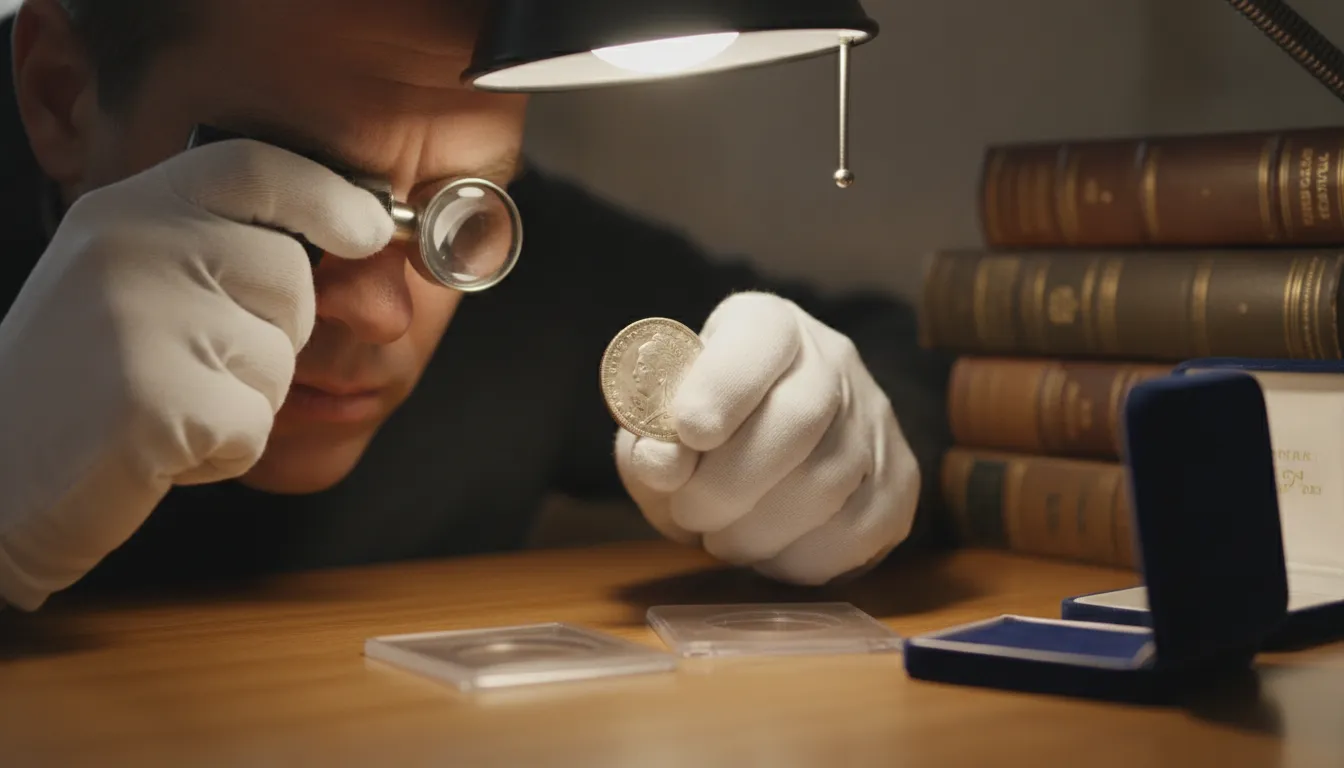
Professional graders evaluate four key attributes: surface preservation, strike quality, luster, and eye appeal, weighing each factor together rather than in isolation.
When a professional examines a coin, the assigned grade reflects a judgment of its physical condition across multiple dimensions.
Surface preservation
Graders examine the coin for marks, scratches, dents, and other surface imperfections. The number, size, and location of these marks matter. Small distractions in focal areas such as the cheek of a bust or the center of a shield can reduce the grade more than similar marks near the rim. Surface problems such as spots, discoloration, or signs of cleaning can change how the surface is assessed.
Strike quality and design detail
The strike refers to how much of the coin's design was transferred during minting. A well-struck coin shows sharp definition in the hair strands, feathers, leaves, and other fine details. Weak strikes are common in certain series, such as early 20th century gold coins. And collectors may accept a softer strike more readily when that is typical for the date.
Luster and eye appeal
Luster: The way light reflects off a coin's surface provides clues about its originality and preservation. Original cartwheel luster on a Morgan silver dollar, for example, is prized by collectors and can lift the grade when other factors are equal. Eye appeal: The overall visual impression also matters. Two coins with similar technical details may not present identically under examination because one has more balanced color, cleaner fields, or fewer distracting marks. Professional coin grading helps separate those observations from assumptions based only on a coin's age or rarity. For more on related topics, see common mint errors worth looking for in your collection.
These factors are considered together, not in isolation. Magnification reveals details you may miss under ordinary room lighting, so handling a coin carefully and avoiding unnecessary cleaning protects the evidence graders need to evaluate it accurately.
PCGS vs NGC: The Two Major Grading Services
PCGS and NGC are the two dominant independent grading services in the United States. Both using the Sheldon scale and placing certified coins in tamper-evident holders with industry-wide recognition.
When you want an independently certified opinion of a coin's condition, PCGS and NGC are the two names you will encounter most often. Both are respected authorities in coin grading, and both place certified coins in tamper-evident holders that help protect the coin and document its assigned grade.
PCGS, or Professional Coin Grading Service, began operations in 1986. NGC, or Numismatic Guaranty Corporation, was founded in 1987. Both use the internationally accepted Sheldon 1-to-70 scale, including Mint State grades from MS60 through MS70 for coins without circulation wear. NGC describes the Sheldon scale as the industry standard in its official grading-scale reference.
| Consideration | PCGS | NGC |
|---|---|---|
| Full name and founding | Professional Coin Grading Service, founded in 1986 | Numismatic Guaranty Corporation, founded in 1987 |
| Grading framework | Uses the Sheldon 1-to-70 scale | Uses the Sheldon 1-to-70 scale |
| Holder features | Secure, tamper-evident holders designed to protect the coin | EdgeView holders with verification features and tamper-evident protection |
| Common reputation | Known for strict grading standards and widely respected by investors and dealers | Known for consistent grading and widely respected by investors and dealers |
These descriptions identify common attributes, not a universal ranking. The grade on an individual coin still depends on its surfaces, strike, preservation, and other characteristics examined by the service. A certified holder gives you useful documentation, but it does not eliminate the need to inspect the coin. Confirm the certification details, and consider the service history that matters to your collection. For that reason, your choice may reasonably depend on the coin, the submission options available to you, and the dealer or collector community you trust.
Raw Coins vs Certified Coins: What's the Difference?
A raw coin has no official grade or holder. While a certified coin has been evaluated by a professional service and sealed in a tamper-evident slab with a documented grade.
When you buy or inherit a coin, it may be raw, meaning it has not been professionally graded. A certified coin has been evaluated by an independent grading service and sealed in a tamper-evident holder. That distinction affects how easily other collectors, dealers, and buyers can assess the coin.
What is a raw coin?
A raw coin is sold without an official grade or protective slab. Its condition may be discussed using terms such as circulated, About Uncirculated, or Mint State, but the assessment is often based on the dealer's or seller's eye. Two people can examine the same raw coin and disagree about its wear, surface marks, or strike quality.
Keeping a coin raw can make sense when it is common, lower value, or still being studied as part of your collection. It can also be practical when the likely benefit of certification does not justify the submission expense. Handle raw coins by their edges and avoid cleaning them, since altered surfaces can complicate evaluation.
What does certification add?
Professional services such as PCGS and NGC assign a grade using the established numerical scale, then identify the coin and place it in a tamper-evident holder. The slab protects the coin while preserving a record of the assigned grade. A certified grade gives buyers a consistent reference point, which can improve price transparency and make the coin easier to compare with similar examples.
For uncirculated coins, the designation begins at MS60. An MS60 or higher coin has no evidence of circulation wear, although marks, luster, strike quality, and other condition details still influence its grade within that range. A certified holder offers stronger buyer protection than an informal opinion alone. For more context, see our guide to understanding coin certification before deciding whether a coin should remain raw or be submitted.
How to Get Your Coins Professionally Graded
Getting coins graded involves deciding whether the coin warrants the fee, choosing a grading service. Having a knowledgeable dealer pre-screen the coin, and submitting it through an authorized channel.
Decide whether grading is worthwhile
Not every coin benefits from certification. The submission fee, shipping, and insurance costs mean the coin should have enough potential value to justify the expense. A common coin in circulated condition may not recoup the grading cost at sale. While a scarce date or a high-grade example of a popular series often benefits from the authentication and grade documentation that certification provides.
Choose an established grading service
PCGS and NGC are the primary choices for U.S. coins. Both maintain strong reputations among dealers and collectors. If you intend to sell soon, research which service commands a slight premium in the specific series you are submitting. Some market segments show small preference differences.
Have a knowledgeable dealer pre-screen the coin
An experienced dealer can examine your coin and give you an honest opinion about whether grading makes financial sense and what grade the coin might receive. Park Avenue Numismatics has been helping collectors evaluate and submit coins since 1988. Speak with a Park Avenue Account Specialist to discuss your coin's potential before you commit to the submission process.
Submit the coin and wait for the result
Grading services require you to submit through an authorized dealer or membership account. The process typically takes several weeks. The service returns your coin in a sealed holder with the assigned grade, a certification number, and a barcode for verification. You can then learn more about what your collection may be worth by visiting the Park Avenue Numismatics about page to understand the team's background and experience.
Common Coin Grading Mistakes Beginners Should Avoid
New collectors often overestimate their coin's grade, clean coins before submission, and submit coins that do not justify the grading fee, leading to disappointment or unnecessary expense.
Cleaning the coin before submission
Cleaning a coin almost always reduces its value and grade potential. Even a gentle cleaning can leave microscopic scratches, dull the luster, or alter the surface in ways graders immediately detect. The best approach is to leave the coin exactly as you found it and let the grading service evaluate its natural surfaces.
Submitting coins that do not justify the fee
If a common-date coin in circulated condition is worth $20 and grading costs $30 to $50, certification may not make financial sense. Research approximate values in your series first. A dealer's opinion can save you the submission cost when the coin is unlikely to benefit from certification.
Assuming your own grade is exact
Self-grading is a useful skill, but graders at PCGS and NGC examine thousands of coins and calibrate their judgments across a team. Expecting your estimate to match the certified grade exactly sets you up for disappointment. Use your assessment as a starting point rather than a guarantee.
Overlooking authenticity and alterations
Grading also serves as an authentication check. Some rare-date coins have been altered, tooled, or counterfeited. Submitting a questionable coin to a grading service can confirm whether it is genuine. If you suspect a coin may have been doctored, have it evaluated before making any significant decision about its value. For more on this topic, see professional coin grading services and error-coin identification.
Frequently Asked Questions
What is the Sheldon grading scale for coins?
The Sheldon scale is a 1-to-70 numerical system used to grade the condition of coins. A coin graded 1 is heavily worn, while a coin graded 70 is considered perfect with no visible imperfections under magnification. The scale was developed in 1949 by Dr. William Sheldon and is the standard used by PCGS and NGC today.
What does MS-70 mean in coin grading?
MS-70 is the highest possible grade on the Sheldon scale, representing a Mint State coin with no distracting marks, hairlines, or imperfections visible under 5x magnification. MS-70 coins are rare in most series and command significant premiums over lower Mint State grades.
How much does it cost to get a coin graded?
Grading fees typically range from $20 to $50 per coin for standard service, plus shipping and insurance. Economy tiers and bulk submission discounts are available through authorized dealers. The fee depends on the coin's estimated value, the turnaround time you select, and whether you submit through a dealer membership.
What is the difference between MS and AU grades?
MS (Mint State) grades from 60 to 70 indicate a coin with no circulation wear. AU (About Uncirculated) grades from 50 to 58 indicate a coin that has only slight traces of wear on the highest design points. The dividing line between AU-58 and MS-60 is one of the most debated distinctions in coin grading.
Ready to Take the Next Step With Your Coins?
Professional guidance can help you understand whether coin grading or an appraisal makes sense for a coin in your collection. Speak with a Park Avenue Account Specialist about your next step. Call 1-888-419-7136 to discuss getting your coins professionally graded or appraised. You can also visit our Miami showroom on Biscayne Boulevard to have your coins evaluated in person.