
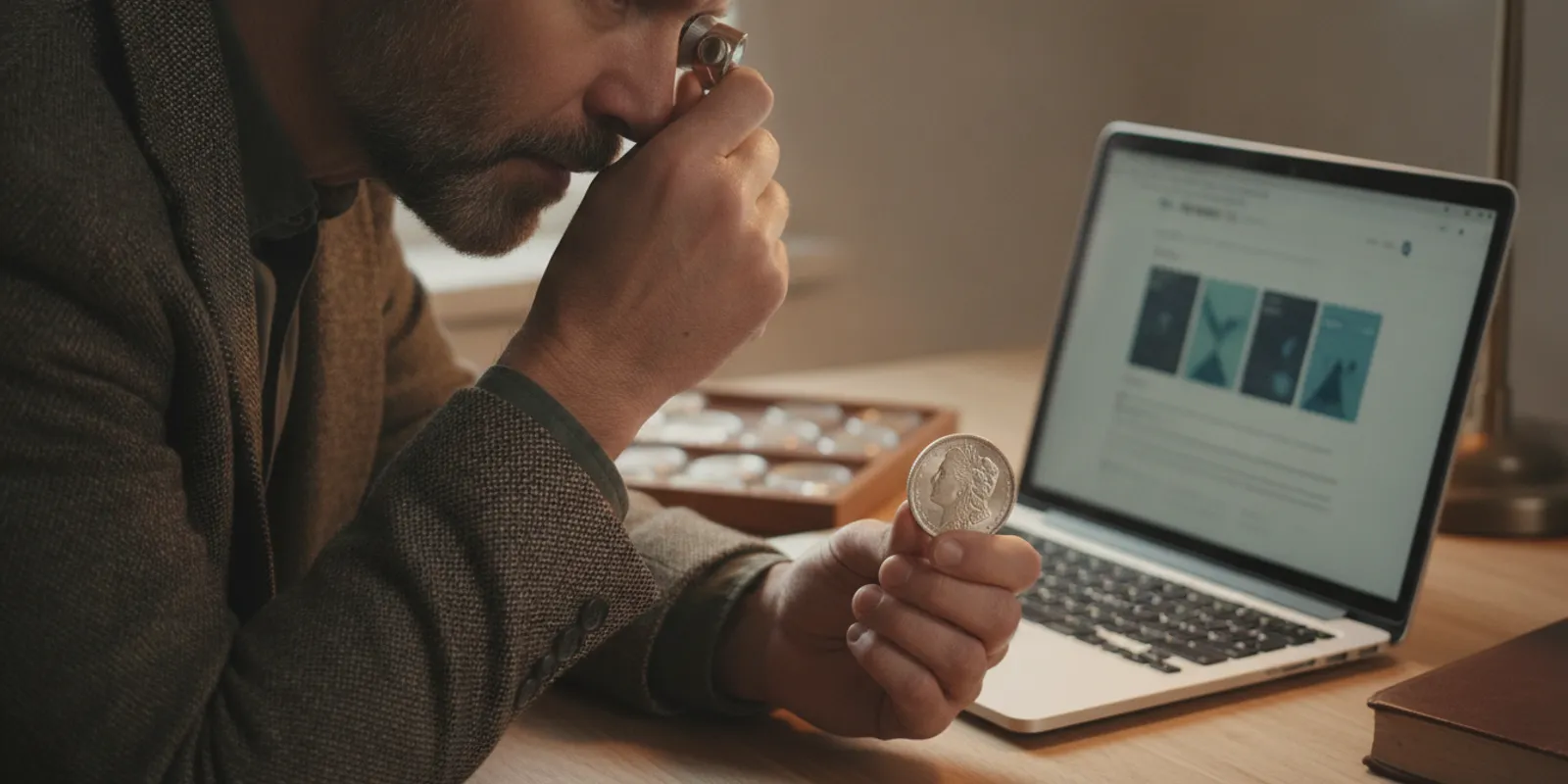
A coin value checker can give you a useful first point of reference, but it cannot settle every question about a coin. To use one responsibly, identify the U.S. coin as accurately as you can, compare like with like, and treat the result as an estimate—not a guaranteed offer or a final appraisal.
Contact Park Avenue Numismatics to discuss a coin
What can a coin value checker tell you?
An online checker or price guide may help you find a broad market reference based on details such as denomination, date, mint mark, and reported grade. It can help you learn what information collectors use and whether a coin merits closer research. The Professional Numismatists Guild offers a coin-value resource that points readers toward market-value information for U.S. coins.
But a number displayed online is not automatically the amount a buyer will pay for the coin in your hand. Listings, guide figures, auction results, and dealer offers can represent different things. They may reflect different dates, grades, demand, selling fees, or transaction conditions. A checker is most useful as a starting point for asking better questions.
Before relying on a result, ask what the tool is measuring. Is it showing an asking price, a completed sale, a guide value, or a broad estimate? Does it identify a specific coin variety and grade, or group many coins together? If its method is unclear, use its output only as a rough research clue.
Which details should you gather before checking a coin?
Accurate inputs matter. A checker can only compare your coin with the details you provide, and a small identification difference can lead to a different group of comparisons. Start with what you can observe without cleaning, polishing, or otherwise altering the coin.
- Country and denomination: Confirm that it is a U.S. coin and note its face value, such as one cent, one dime, or one dollar.
- Date: Read the year carefully. Use good light and magnification if needed, but avoid scraping or rubbing the surface.
- Mint mark: Look for a small letter that may identify where the coin was struck. Its location differs by design, so check a reference for the specific type.
- Design or type: Note the design and visible differences. A Morgan dollar and a Peace dollar are both U.S. silver dollars, but they are distinct types.
- Condition: Describe what you see, but do not assume a grade from a single photograph. Wear, marks, luster, and surface quality can all matter.
- Certification: If a grading service has encapsulated the coin, record the service and grade on the label. A holder alone does not prove authenticity.
- Background records: Keep receipts, collection notes, or ownership history that came with it. These may explain provenance, though documents should be assessed rather than taken as proof by themselves.
Photographs can help with identification. Take clear images of both sides in even light, and include a close view of the date and mint mark when visible. Keep the coin steady and avoid glare. A photograph documents what is there; it is not a reason to clean the coin or remove it from a holder.
Make a simple identification record
Before opening a checker, write down the details you can confirm and separate them from guesses. For example, record “1904 Morgan dollar; mint mark appears to be S, needs confirmation” rather than treating an uncertain letter as certain. Note where on the coin you saw the mark and whether it is partly obscured. This small distinction helps you avoid entering a confident but possibly incorrect answer.
If you are reviewing several coins, give each one a separate line in a notebook or spreadsheet. Include a short description, date and mint mark, certification label if present, photo file name, and source of any estimate. Do not combine a group into one average; a collection can contain coins with very different types, conditions, and collector interest. A clear record also lets you return to a question later without having to repeat the entire identification process.
How should you use a coin value checker step by step?
- Identify the type first. Use the date, denomination, design, and mint mark to narrow down what you have. If a detail is uncertain, note the uncertainty instead of guessing.
- Choose a source that explains its figures. Look for a checker or reference that says whether its data comes from asking prices, completed sales, or another basis. Prefer results detailed enough to compare the same type and relevant grade.
- Enter only details you can support. Do not select a high grade just because the coin looks bright, or choose a scarce variety based on a vague resemblance. Use a conservative description and record alternate possibilities for review.
- Compare closely matched examples. Match the year, mint mark, variety, certification status, and grade as closely as possible. A general result for an entire series is not a close comparison for one coin.
- Check the date of the information. Coin markets change. Recent and relevant data is generally more useful than a figure with no date or a result from a different market period.
- Keep a note of your research. Record the checker, date, coin details entered, and the range or examples it returned. This makes it easier to revisit the estimate as you learn more.
- Pause before making a decision. If the estimate depends on an uncertain grade, variety, or authenticity, seek a closer examination before treating the number as a basis for a sale.
Suppose you find a U.S. silver dollar and enter its year. A result for that year alone may combine circulated coins, high-grade examples, different mint marks, or scarce varieties. The next step is not to choose the largest number. It is to establish which comparison actually matches your coin.
How to compare results instead of chasing the highest figure
When a checker returns a range or several examples, first remove comparisons that clearly do not match. A listing for a different mint mark, a different variety, or a much higher grade may be interesting background, but it is not a reliable stand-in for your coin. Then check whether the remaining examples are current and whether the displayed amount refers to an asking price or a documented sale.
Look for a cluster of comparable examples rather than building a conclusion around one unusually high or low entry. If the numbers still vary widely, write down what differs: grade, certification, venue, date, or sale terms. You may discover that the sources are answering different questions rather than disagreeing about an identical coin. If the difference hinges on a detail you cannot verify, mark it as unresolved instead of selecting the result that feels most favorable.
A practical note could say that the tool gives a broad range for the date, while two recorded examples have a different mint mark and the grade remains unconfirmed. That description is more useful in a later conversation than a bare number copied from a screen. It gives a professional a clear starting point and helps keep an estimate in its proper role: evidence to investigate, not a promise.
Why can two estimates for the same coin differ?
Different tools can return different figures because they may rely on different kinds of data. One may display seller asking prices. Another may use recorded sales, guidebook information, or an automated estimate. An asking price shows what a seller hopes to receive, not necessarily what a buyer paid. A completed sale may be more concrete, but it still depends on the exact coin and terms of the transaction.
Even sale records that appear similar may not be directly comparable. One coin may have a stronger strike, fewer distracting marks, a different certification, or a more appealing surface. A sale might include fees or reflect a particular venue. Markets can shift over time. Look for a pattern across well-matched examples rather than treating one result as definitive.
The table below summarizes how to read common online references:
| Reference shown | What it may represent | How to use it |
|---|---|---|
| Current asking price | A seller’s listed amount for an offered coin | Use as a comparison point, not proof of a completed sale or expected offer. |
| Recorded sale | A reported transaction for a particular coin at a particular time | Compare date, mint mark, grade, certification, venue, and sale terms. |
| Price guide figure | A reference value compiled under the publisher’s chosen method | Read the guide’s explanation and date; do not assume every buyer uses it. |
| Automated estimate | A result generated from details entered and available data | Check whether the tool identified the exact variety and condition correctly. |
| Dealer assessment | An evaluation in the context of a potential purchase | Ask what characteristics were considered and what the assessment covers. |
Use the table as a checklist when two sources appear to conflict. For example, if one page shows an active listing and another shows a past transaction, they are not directly equivalent evidence. Note what each source reports before comparing the amounts. Some databases may also omit fees, buyer premiums, or other transaction details, so do not assume a displayed result represents the same net amount in every setting.
How do condition and grade affect an estimate?
Condition is one reason a value checker can miss the mark. A coin’s grade describes its state of preservation, but it is not simply a count of scratches or a judgment that the coin looks attractive. Wear on high points, strike sharpness, marks, luster, and surface quality can all affect an assessment. The importance of each feature varies by coin type.
Two coins with the same date and mint mark may therefore be very different examples. A circulated coin may show wear in important parts of its design. A coin with little wear may still have marks or surface problems that influence its grade. Lighting and camera angles can hide or exaggerate features, so estimates based on a photograph need care.
For comparison, study examples of the same type across different grades and note what changes on the coin, not just the number assigned to it. Park Avenue’s listing for a certified 1940 Lincoln cent shows the kind of specific coin and certification details that a broad checker may not capture. It is an example, not a valuation of another coin.
Do not clean a coin to make it look brighter before taking a photograph or showing it to a professional. Cleaning can change its surfaces and may affect how it is assessed. Handle it carefully by the edge, and keep it in a suitable holder if it is already protected.
When viewing photos of comparison coins, pay attention to what the images can and cannot show. A straight-on image may reveal the overall design and some marks, while a slight change in light can make luster appear stronger or weaker. A photograph rarely captures every surface characteristic. If an online tool asks you to choose a grade, use it to explore how different grades affect results, not to certify that your own coin belongs in one category. Keep your grade estimate separate from the coin’s confirmed identification.
Why do attribution and authenticity need a closer look?
Attribution means identifying exactly which coin or variety you have. A date and mint mark may not tell the whole story. Some designs have recognized varieties or small differences that can be difficult to see without a reference or close examination. Park Avenue’s overview of Barber dimes dated 1892–1916 is a starting point for learning one U.S. coin series. A checker may not ask about these details, or its options may not match your coin.
Authenticity is a separate question. A coin can look convincing in a photo and still need examination. Altered, counterfeit, or misattributed pieces can resemble genuine U.S. coins to an inexperienced viewer. A digital result based on a selected date or uploaded picture cannot establish that a coin is genuine. If there is uncertainty, avoid modifying it and have it examined by a knowledgeable professional.
Certification can provide helpful information when a coin has been evaluated and placed in a holder by a grading service. Still, confirm that the label describes the coin you are researching, and consider the coin and holder together. A checker that ignores certification or treats all grades as interchangeable may not compare equivalent examples.
What role do provenance and current demand play?
Provenance is the documented history of a coin’s ownership or collection background. It can help establish context, especially when records connect the coin to a known collection or earlier sale. But a story without supporting records is not the same as verified provenance, and paperwork should be reviewed for relevance and consistency.
Demand is not fixed. Interest can vary among dates, mint marks, designs, grades, and certified examples. A coin that is easy to find in one condition may be harder to locate in another. Buyers may also differ in what they seek. A historic checker result or a single reported sale should not be read as a promise about what a coin will bring today.
For gold and silver coins, collectors may consider both numismatic characteristics and the metal involved, but these are not interchangeable ways to determine a final purchase figure. The individual coin, its condition, authenticity, demand, and current market all matter. Park Avenue Numismatics also provides information about buying silver in Miami; each coin still needs to be considered on its own.
What if you are researching an inherited group?
If you are sorting coins inherited from a family member, begin by keeping the group organized rather than trying to assign one figure to the entire collection. Separate coins only when you can do so safely and without disturbing holders or labels. Photograph both sides, note any written labels or accompanying records, and record which items were stored together. That context may help later, but it does not by itself verify a coin’s identity or history.
Use a checker to learn the basic vocabulary and identify questions, not to make a fast decision about every piece. A broad result may not distinguish a common date from a less common mint mark, or a circulated coin from one in a different condition. If several coins appear similar, avoid assuming they are identical until you check each date, mint mark, and any visible variety. A short inventory lets you prioritize coins with uncertain attribution, certification, or unusually wide estimate differences for closer review.
When is a professional review useful?
A professional review can be useful when you cannot confidently identify a mint mark or variety, when online comparisons vary widely, or when an estimate appears to depend on a high grade. It can also help when authenticity is uncertain, when you have a group of mixed coins, or when you want to understand how condition and demand apply to a specific piece.
Bring the coin as it is. Share clear photographs if you are asking an initial question, and include the date, mint mark, denomination, and certification information you can read. Bring ownership records or prior assessments if you have them. Do not present an online estimate as a guaranteed value; explain what source produced it and ask how the professional’s assessment differs.
To make the conversation practical, prepare a few focused questions. Ask which details of the coin most affect the assessment, whether the comparison sources you found are relevant, and which uncertainties remain. If a coin is certified, point out the label and ask whether the grade and identification match the piece. If the coin is part of a larger collection, bring your inventory so the discussion can distinguish individual items rather than relying on a broad group description.
Park Avenue Numismatics has served Miami coin and precious-metals sellers since 1988. If you are considering an in-person conversation, use the contact page to discuss next steps. An assessment depends on the coin’s characteristics and the market at the time; no online checker can guarantee a purchase price.
Discuss your coin with Park Avenue Numismatics
Frequently asked questions about coin value checkers
Are online coin value checkers accurate?
They can provide a helpful starting reference when you identify the coin correctly and understand what kind of data the tool shows. They may be less useful when grade, variety, certification, or authenticity is uncertain. Compare the result with relevant examples and treat it as an estimate.
Should I use a coin value checker before selling?
It can help you prepare questions and gather coin details before discussing a possible sale. Keep notes on sources you used, but do not assume a guide figure or listing price equals an offer. A buyer’s assessment considers the individual coin and current market conditions.
Can I determine a coin’s grade from a phone photo?
A clear photo may help with basic identification, but it often cannot show every detail needed to assess condition. Glare, focus, angle, and lighting can affect what is visible. Avoid cleaning or altering a coin to improve a picture; have it examined if grade matters to your decision.
Does a certification label guarantee a coin’s value?
No. A label may identify a coin and state a grade from a grading service, but it does not guarantee a market price or a buyer’s offer. The coin’s specific characteristics and current demand remain relevant.
What should I do if different checkers show different results?
Review what each source measures, when its data was updated, and whether the comparison matches the coin’s type, date, mint mark, grade, and certification. If important details remain uncertain, ask a qualified professional to examine the coin before drawing a conclusion.
A coin value checker is most useful when it helps you identify what you still need to learn. Confirm the coin’s details, compare relevant evidence, and seek an informed review when the estimate depends on condition, authenticity, provenance, or changing demand.





